|
| Pot-roasted Chicken "Stewp" with Herbs, Garlic and Bacon |
Now the moan. (I called it a 'lament' in the title of this post only because I'm trying to cover my dainty behind: recently, in a presentation at the South African Food Bloggers' Conference, I advised bloggers never, ever to complain or whinge in a blog post.)
Anyway: many food bloggers will agree that having to take photographs of food can be pain in the neck. It's not that styling and photographing your own food isn't fun - it can be hugely rewarding, especially when you've learned a few basic tricks (necessary if you have an elderly camera, as I do), and the winning picture looks just beautiful.
The problem is finding the time - and getting the time of day right.
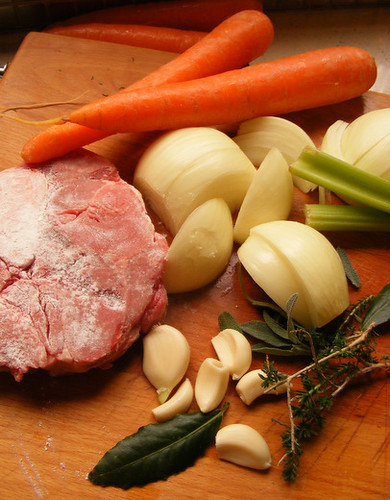
Here's why: food needs to be photographed in natural light (a flash is the kiss-of-death to a plate of food), and that usually means taking the picture in cool morning light, or at the very least before noon. If you're going to photograph really freshly cooked food, you have to get up early in the morning to cook it. And who has time to do that? Not I, said the little red hen. This blog isn't my job, and my early mornings are gobbled up by school lifts and making of lunch boxes. It's only once I've done a morning's work, and all the afternoon's school lifts and child-admin stuff, that I can hit the kitchen, and by that time the light is too yellow and low-slanting to take a good photograph (the photograph on this page is a good example). So, a few choices: keep some of the food aside to reheat and photograph the next morning, or cook-and-snap on Saturday and Sunday mornings. Neither approach is ideal: the former results in sulky-looking food, and the latter in sulky-looking family members.
And, having said that, I'm actually one of the lucky ones, living as I do in the southern hemisphere where the light is clear and brilliant for most months of the year. At the Food Bloggers' Conference, my pal Jeanne Horak-Druiff of Cooksister! (a South African living in London) had us in stitches as she described her frustration at having to take photographs of her beautiful food on dismal winter evenings. Jeanne set up a special mini-light-box-cum-studio in her conservatory, but was repeatedly defeated by air so arctic that the hot food steamed up her lens.
Why, you may ask, bother to post a photograph at all? Well, the truth is that a food blog without photographs is like a cartoon without illustrations. No matter how original and mouth-watering your recipes, and how brilliant your writing, no one will pay your blog much attention unless it is lavishly illustrated with food photographs. Okay, they don't need to be as perfect as food-magazine pictures (the food-blogging community, competitive as it is, can be very forgiving), but they do, at the very least, need to be sharp, bright and good-looking.
So what's the point of my moan? Nothing, really, except to commiserate with all those other food bloggers who labour in their kitchens to produce excellent recipes, and then decline to post them because they haven't had a chance to take a photograph, or because they took a pic that looks like something the cat sicked up.
If it's any consolation: none of the world's most esteemed food writers take publishable pictures of their own food. I've never seen Gordon, Nigella, Jamie or Nigel with a camera in their hands. They have professional photographers to do this, expert cooks to make the actual dish, and stylists to scatter the parsley and toast the pine nuts. They have home economists to work out the measurements, and editors to tweak the grammar. You, my dears, do this all on your own, and that's what makes your blogs amazing.
On the subject of food photography, please take a look at the work of Nina Timm of My Easy Cooking, who is the reigning queen among South African food bloggers when it comes to photography and food styling. This is the standard of food photography that I aspire to.
But back to the stewp.
This recipe uses two chickens, but you can easily halve the recipe. Do take the trouble to drain off excess fat, as instructed in the recipe, or you will end up with a greasy gravy. You need nice, thick, smoked pork rashers for this dish - watery supermarket bacon will not do. Ask your butcher.
Pot-roasted Chicken "Stewp" with Herbs, Garlic and Bacon
2 large free-range chickens
salt and milled black pepper
a small bunch of mixed fresh herbs of your choice: sage, oregano, basil, parsley and thyme
8 cloves fresh garlic, peeled and finely chopped
the zest and juice of 2 small lemons
6 Tbsp (90 ml) olive oil
6 smoked pork rashers (about 180 g; each about 7 mm thick), cubed
3 onions, peeled and cut vertically into eighths
2 sticks celery, sliced
24 peeled baby carrots (or 10 medium carrots, peeled and cut in half crossways)
3 Tbsp (45 ml) cake flour
2 cups (500 ml) dry white wine
2 thumb-length sprigs fresh rosemary
8 large potatoes, peeled and halved crossways
Heat the oven to 150°C. Using the flat of your hand, press down firmly on the breasts of the chickens until you hear the breast bones snap. Season inside and out with salt and black pepper.
Strip the herb leaves from their stalks and chop the leaves fairly finely. Place in a bowl and add the chopped garlic, the lemon zest and 2 Tbsp (30 ml) of the olive oil. Season with salt and pepper and mix well. Now make a 'pocket' at the top of the chickens by very gently separating the breast skin from the flesh: slide your fingertips under the skin on top of the breasts, breaking the fine membrane as you go to create a pouch. Take half of the herb paste and spread it evenly under the breast skin of both chickens (reserve the remaining mixture). Pull the breast skin back into place.
Heat another 2 Tbsp (30 ml) of olive oil over a brisk flame flame in a large ovenproof dish (a big cast-iron pot is ideal; a sturdy roasting pan will also do). Brown the chickens all over in the hot oil, turning frequently: this should take between 12 and 15 minutes. Don't worry if they're not evenly golden brown: what's important is that there's a sticky honey-coloured residue on the bottom of the pan.
Remove the chickens from the pan and set aside. Add the cubed pork rashers to the pan and fry for 3 minutes, or until just crisp and golden brown. Remove from the pan using a slotted spoon and set aside. Drain all the chicken and bacon fat from the pan, but don't wipe it out.
Put the remaining 2 Tbsp (30 ml) olive oil into the pan, add the onions, celery and carrots and fry over a medium-high heat for 4-5 minutes, or until the onions begin to colour. Sprinkle the flour over the vegetables and cook for two minutes, stirring. Add the wine and lemon juice to the bowl containing the left-over herb paste, stir well, then pour the mixture over the vegetables, stirring briskly to release any sediment and to prevent lumps forming. Cook the sauce gently for a two minutes, or until thickened.
Place a sprig of rosemary inside the cavity of each chicken. Rest the chickens, breast-side up, on top of the vegetables in the pan, and arrange the potato halves around them. Using a large spoon, baste the chickens and potatoes with the winy liquid. Cover with a lid, or a tight layer of tin foil, and cook at 150°C for an hour and 45 minutes, or until the potatoes are very tender, and the chicken is falling off the bone. Give the pan a shake now and then, and baste the chicken with the juices. Pull the chicken to joints, and serve immediately, in deep bowls, with hunks of bread.
Serves 8.
 Print Friendly