Saturday, 10 April 2010

Oven-Cooked Hearty Beef and Carrot Stew

Oven-Cooked Hearty Beef and Carrot StewA rich, herby, gooey gravy makes this simple beef stew ideal for a family dinner on a chilly evening. It takes only 15 minutes to prepare, after which it's kicked into the oven and left to burble for a good three hours, or more.

Browning cubes of meat is tedious, but this caramelising of the meat's surface does help to give the sauce a lovely depth of flavour.

However, I've found that you don't need to brown the whole lot: you can get away with browning just a third of the beef cubes (or enough of them to create a sticky brown layer on the bottom of the pan).

Any good stewing beef will do for this recipe - chuck, blade or skirt - but I like it best using boneless shin, which doesn't go stringy after a long cooking time.
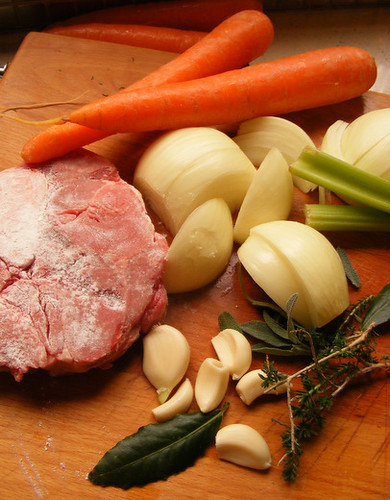
Oven-Cooked Hearty Beef and Carrot StewThe gremolata of finely minced lemon peel, garlic and parsley adds a final sparkle to the stew, but do prepare it - and sprinkle it on - at the very last moment, so that the heat of the stew releases a billowing cloud of zesty aromas.  The carrots are added in two stages: if you put the baby carrots in at the beginning, they'll turn mushy and brown.


This stew contains a quite lot of flour (I can't bear a stew with watery gravy); if the sauce is too thick, thin it down with extra wine or water.  You can prepare this dish in advance, and reheat it at supper time (in fact, like all stews, it's better the day after).

Oven-Cooked Hearty Beef and Carrot Stew
1.5 kg boneless shin, or similar stewing beef
3 T (45 ml) olive oil
½ cup (125 ml) white flour
salt and milled black pepper
2 red onions, peeled and quartered
2 large carrots, scraped and cubed
a stick of celery, finely sliced
3 cloves garlic, peeled and chopped
1 cup (250 ml) red wine
1 tin Italian tomatoes, chopped
3 T (45 ml) tomato paste
2 T (30 ml) dark soy sauce
4 fresh sage leaves, sliced
3 sprigs of thyme, leaves stripped
2 bay leaves
a small sprig of rosemary
about 750 ml hot water
18 baby carrots

For the gremolata:
a lemon
2 fat cloves garlic, peeled
a small bunch of parsley

Preheat the oven to 160°C. Remove any stringy bits from the beef and cut into large cubes. Heat the oil over a brisk flame in a large, shallow oven-proof dish or casserole. Put the flour in a bowl and season with salt and pepper. Add the beef and, using your hands, toss well so that every cube is coated.  When the oil is hot, add a third of the beef cubes and cook, over a brisk heat, until they are crusty and golden brown. (You can brown all the meat in this way, if you have the patience.) Remove from the heat and set aside. Turn down the heat slightly and add the onion, carrot, celery and garlic. Cook for a few minutes -  without allowing the garlic to brown - or until the vegetables are slightly softened.

Now add the red wine, tomatoes, tomato paste, soy sauce and all the herbs. Stir well to combine, scraping to release any sediment on the bottom of the pan.  Return the browned beef and its juices to the pan, along with the rest of the meat and flour, and cook for a minute, stirring well to prevent lumps forming. Add just enough hot water to cover the beef and vegetables to a depth of 5mm. Check the seasoning and bring to the boil, stirring well.  Cover the pot with its lid (or a double layer of tin foil) and place in the middle of the oven. Cook for an hour, then turn the heat down to 150°C and cook for another hour.  Remove the pot from the oven, stir in the baby carrots, cover and return to the oven for another hour, or longer (your cooking time will depend on your oven and the cut of beef you're using; the stew is ready when the meat is fork-tender, and the carrots are tender).

To make the gremolata, finely grate the lemon zest and the garlic (a microplane is perfect for this job) and finely chop the parsley. Combine in a small bowl. Just before serving, sprinkle the gremolata over the hot stew.   Lovely with hunks of bread or mashed potato.

Serves 6.
Print Friendly and PDFPrint Friendly

Thursday, 8 April 2010

Fresh-Plum and Almond Cake, and a bitter taste in one's mouth

Made in a jiffy in a food-processor, this cake involves no more effort than measuring out the ingredients  and stoning the plums. The result? A light, almond-scented cake concealing hot nuggets of sweet-sour plum. Like all my recent fruit-plus-cake experiments, this is really a cross between a cake and a hot pudding, and it's best eaten warm, on a cold night, in your bed, with lashings of cream or custard.  Or both.

Fresh-Plum and Almond Cake
The cake, before it's baked
Plums are in full glut in South Africa now, as they are every autumn, and so ridiculously cheap and luscious that I just can't resist buying them by the basketful.  I can rely on my kids to demolish most of the plums I buy, but there are often a few left-overs rolling around in the fruit bowl, getting softer, sweeter and juicier as they  begin to wrinkle.

Turfing them into a cake for my pudding-crazed family was all I could think of (although I had to make this cake twice before it was just right).

On the subject of 'inventing' a cake: someone emailed me the other day to ask how I make up cake recipes from scratch.  The answer?  Of course I bloody well don't:  I'm not a Delia or a Nigella (the verrry thought!), and I'm certainly not a natural baker. What I do is to take an existing cake recipe - and there are really only four or five good basic formulas for cake - and adapt it.  Most times I use a tried-and-tested recipe from my mum's hand-written cookbook (Jack's Granadilla Cake is a good example); sometimes I refer to my collection of vintage recipe books and pamphlets from the 50s and  60s, which are packed with precise and delicious cake recipes.  You can find books like these in heaps in second-hand bookshops and charity shops - nobody wants them any more.

Fresh-Plum and Almond Cake
This is a cake for eating in bed.
Before I give you this recipe, an interesting story about having a bitter taste in one's mouth.  No, I'm not annoyed or feeling sour!  Last week, as we were about to embark on a family camping trip, and bickering as we packed the car and made the padkos, my husband complained that his mouth was filled with a bitter, sour taste.  'I'm not surprised, given your attitude', I snarled, wrestling some sausages into a blikkie. 'Thanks for that, darling,' he growled, shoving the moth-eaten sleeping bags in the boot. 'You'll be so sorry when you find out I've got a brain tumour.'

By the time we were seated around a crackling campfire a few hours later, and with the help of some nice cold white wine and sizzling boerewors, we were all feeling less grumpy, but the bitter taste in Flip's mouth had worsened. No amount of tooth-brushing or rinsing or Coca-Cola-swigging helped, and the foul taste persisted for a full 48 hours. When we got back to Cape Town, he googled the problem, and an extraordinary culprit emerged.

Pine nuts. According to a recent report, eating pine nuts can leave a foul, acrid taste in your mouth for up to three days. This has been dubbed 'pine mouth', says the always-sensational Daily Mail: 'Increasing numbers of people have reported that after eating pine nuts, typically as a snack or in a pesto sauce, they have developed a foul, metallic taste in their mouth lasting for up to two weeks, making practically all food and drink unpalatable.'  

Postscript, February 2013:  Scientists have not yet figured out what chemical compound causes this foul taste; more about this in a 2012 report >  Cause Of Foul Pine Nut Taste Befuddles Scientists.

I was relieved, naturally, that there was no brain tumour (a 'brain tuna', my son called this when he was three), but I was also infuriated that my stash of extremely expensive pine nuts - which I'd hidden in a door compartment in the fridge - had been discovered and demolished.  I was tempted to bliksem him with a rolling pin - but, then again, I reckoned he'd suffered enough.  

It's only today that the bitter taste has finally disappeared. And this plum cake was the first thing that my beloved got to taste, after almost a week of  living with deadened tastebuds. He loved it - well, of course he would!

Fresh-Plum and Almond Cake

6 large ripe plums
2 cups (500 ml) white cake flour
2½ tsp (12.5 ml) baking powder 
a pinch of salt
180 g soft butter
1½ cups (375 ml) caster sugar
4 eggs
1 cup (250 ml) ground almonds
1 tsp (5 ml) almond extract, or essence
1 cup (250 ml) milk

To serve:
100 ml flaked almonds
icing sugar
whipped cream

Heat the oven to 160°C. Line the bottom of a 23-cm non-stick cake tin (preferably a spring-form tin) with a circle of greased baking paper.

Cut the plums in half, along their seams. Remove the pips, using the point of a sharp knife, and set aside.

Sift the flour, baking powder and salt on to a plate. Put the butter, caster sugar, eggs, almonds, almond extract and milk into a food processor fitted with a metal blade. Turn on the processor, and whizz the mixture together for a minute.  Now open the top of the food processor and tip in the sifted flour/baking powder/salt mixture. Whizz, on a high speed, for another minute.  Don't worry if the mixture looks slightly curdled: all will come right in the baking.

(If you don't have a food-processor, simply combine all the ingredients in a large mixing bowl, using a large balloon whisk.)

Pour the batter into the prepared baking tin.  Press the halved plums, cut side up, into the batter. It doesn't matter how far you sink them in - they will all end up at the bottom of the pan.  Tap the cake tin sharply on the counter a few times to pop any air bubbles.  Place in an oven heated to 160°C and bake for an hour and twenty minutes, or until the cake is pulling away from the sides of the tin, and an inserted skewer comes out dry.

In the meantime, put the flaked almonds into a dry frying pan and toast, over a medium heat, until they're just beginning to turn golden brown. (Or toast them on a baking sheet in a moderate oven.) Remove from the heat and set aside.

Take the cake out of the oven, allow to cool for five minutes, and then run a sharp knife around the edges of the tin to release the cake.  Invert the cake onto a plate, flip off the metal bottom of the cake tin, and peel off the baking powder.  Turn the cake the right side up again.  Put the icing sugar into a tea-strainer (or sieve), and generously dust the top of the cake with it.  Sprinkle the toasted almonds over the cake.

Serve warm, with whipped cream.

Makes one 22-cm cake. 

Print Friendly and PDFPrint Friendly

Tuesday, 6 April 2010

Curry in a Hurry: Spicy Prawns with Paprika and Coconut Milk

A perky sauce made with fresh spices and coconut milk can work wonders with prawns that have come straight from the freezer. It can also perform miracles with defrosted prawns that have been abandoned - by a gin-giddy cook - in their lemon-garlic marinade for a full 36 hours.

Spicy Prawns with Paprika and Coconut Cream
Plate by David Walters
I was intending to flash-fry these prawns as a late-night snack for guests at my husband's 50th birthday party last week, but lost all interest in the idea once the party was in full swing (and - okay - once I had a number of beetroot-and-gin shots under my belt).

It was hardly a great surprise that  no one felt like eating prawns the day after the party ('Don't point your fokken tentacles at me!' growled my husband when he found them in the fridge, quoting his favourite line from the movie District Nine). But I certainly was not going to throw away two boxes of plump Italian prawns -  which I'd bought on a special at Woolworths -  no matter how sulky they might have felt at being left to languish in the fridge. I'm not going to pretend that they had the bounce of fresh prawns harvested at dawn from limpid waters, but I was surprised to find that they were still sweet and succulent, and as springy between the teeth as any prawn that's done time in a deep-freeze

You could use prawn tails for this recipe, but your sauce won't have the rich flavour that comes from the juicy heads and other whiskery bits.

Note: my prawns were still okay to use after 36 hours because of the preserving qualities of the lemon juice and salt.  If you're defrosting prawns, I recommend you use them within 4 hours.

Curry in a Hurry: Spicy Prawns with Paprika and Coconut Milk

1.5 kg whole frozen prawns, defrosted for 1 hour

For the marinade:
3 cloves garlic, peeled and crushed
juice of 2 lemons
2 T (30 ml) olive oil
1 tsp (5 ml) salt

For the sauce:
3 T (45 ml) olive oil
1 thumb-length cinnamon quill
2 tsp (10 ml) black mustard seeds
10 curry leaves
340 ml coconut milk
1 T (15 ml) freshly ground cumin
1½  tsp (7.5 ml) paprika [smoked paprika if you can find it]
1½  tsp (7.5 ml) red chilli powder or chilli flakes [to taste]
1 tsp (5 ml) turmeric
milled black pepper and salt
the juice of a lemon

To serve:
6 spring onions
a small bunch of fresh coriander
paprika

Devein the prawns and place them in a bowl.  Add the garlic, lemon juice, olive oil and salt and, using your hands, toss well so that every prawn is lightly coated. Cover and place in the fridge for an hour or two. Heat the olive oil in a large frying pan or a paella pan. Add the cinnamon quill, mustard seeds and curry leaves and fry, over a brisk heat, until the mustard seeds begin to pop and crackle.  Add the prawns and cook, tossing frequently, for a few minutes, or until the prawns have turned to a rich coral colour.  Turn down the heat and stir in the coconut milk, cumin, paprika, chilli powder and turmeric. Cook gently - a slow bubble is just right -  for 5 minutes.  In the meantime, finely slice the spring onions (all the white parts, and some of the green) and chop the coriander. Season the prawns with pepper and add a little more salt if necessary. Squeeze the lemon juice over the prawns and toss to coat.  Tip the prawns onto a heated platter and sprinkle with the spring onions and coriander, and a dusting of paprika.

Serves 4. Print Friendly and PDFPrint Friendly

Thursday, 1 April 2010

Borscht in Small Glasses: Iced Beetroot and Gin Shots

Beetroot and Gin Shots
Iced Beetroot and Gin Shots
Here's an idea for a zinging cocktail: cool, earthy beetroot soup, spiked with gin and served in smoking-cold shot glasses. I made this, last weekend, for my husband's 50th birthday party. I laughed my pants off when a guest (my sister, I think it was) said: 'What's good about this recipe is that it contains Vitamin C, and Vitamin G.'

Vitamin G being, of course, neat gin, a nutritious basic foodstuff for anyone over the age of 40. Or fifty.

Earlier that morning, in a pre-party kitchen frenzy, I'd wrapped six tennis-ball-sized beetroot in foil and put them in the oven, with a view to making my beetroot hummous. When I took the parcel out of the oven at noon, I was feeling grumpy, footsore and frazzled, and wondering how the hell I'd feed the 40 people expected at the party, considering I'd made only three trays of  hors d'œuvres (or horse-da-oovrays, as they are known in my family).

But my mood improved when I opened the foil and inhaled the glorious scents of earth, water, stone and blood: what I craved, I realised on the spot, was a borscht (of corscht!); very cold, with ginsk. And spring onionsk.

If you've read this far down, you must be a lover of beetroot.  And, if so, I don't think I need to sing its praises to you.

Here's what Tom Robbins had to say about beetroot in his novel Jitterbug Perfume:  "The beet is the most intense of vegetables. The radish, admittedly, is more feverish, but the fire of the radish is a cold fire, the fire of discontent, not of passion. Tomatoes are lusty enough, yet there runs through tomatoes an undercurrent of frivolity. Beets are deadly serious." 

You do need a good vegetable stock to give this soup some depth. In this recipe, the peelings of the baked beetroot are combined with basic vegetable flavourings to make a tasty broth.

A big mistake I made, on the eve of this party, was that I didn't chill the soup for long enough. It needs to be very cold (but, then again, not so icy that it numbs your tastebuds).  Next time, I'll chill the shot glasses in the freezer before I serve it.

Beetroot and Gin Shots
6 large beetroot, or 12 smaller ones

For the stock:
1 stick celery, chopped
3 stalks parsley
a large carrot, scraped and roughly chopped
1 onion, peeled and quartered
1 clove
1  bay leaf
6 peppercorns
½ tsp (2.5 ml) caraway seeds
1 tsp (5 ml) salt
1.2  litres water
beetroot trimmings [see recipe]

To serve:
white pepper
1 tsp (5 ml) Tabasco sauce
300 ml gin, or more, to taste
small spring onions, trimmed

Preheat the oven to 180°C. Trim the leafy tops off the beetroot, leaving 5 cm of stalk intact. Wipe the beetroot with a cloth, but don't wash, peel or cut them. Wrap them in a double layer of foil and place in the oven.  Bake until completely tender when pierced with a sharp knife (how long this will take will depend on the size and age of the beetroot; for baby beetroot, an hour is enough. Very elderly beets can take up to 3 hours.)  Remove the packet from the oven and allow to cool.

Put a piece of newspaper or greaseproof paper on your kitchen counter. Trim the beetroot of stalks and roots, slip off their skins, and set all these trimmings to one side. Quarter the peeled beetroot and place in the goblet of a liquidiser.  Blitz until you have a fine purée (if the mixture is too thick for the blades to turn, add a little water).  Pour into a large bowl and refrigerate.  Now make the stock:  put the reserved beetroot trimmings into a saucepan and add the remaining stock ingredients. Bring to the boil, then turn down the heat and simmer for an hour, topping up with water every now and then if necessary, and skimming off any foam.

Strain the stock through a colander onto the chilled beetroot purée.  Add the Tabasco sauce and season with white pepper, and a little more salt, to taste. Stir well.

Now pass the soup through a fine sieve. Place in the fridge again and chill for two to three hours. An hour before serving, place the shot glasses and the gin in the freezer.  Remove the soup from the fridge and stir in the cold gin.  Put the soup into a jug with a sharp pouring nozzle and fill each glass almost to the brim.  Add a spring onion to each glass. Serve immediately.

This recipe makes 36 shots of 60 ml (4 T) each, or two litres of soup (which will serve 8 people, as a starter). Print Friendly and PDFPrint Friendly