Showing posts with label soup. Show all posts

Friday, 9 March 2012

Ten top tips for making memorable soup, and MasterChefSA blogging

My Roast Ratatouille Soup with Basil Mayonnaise
There's an agreeable crispness in the air in the mornings here in Cape Town, a sure sign that autumn's on its way. Never mind Keats's season of mists and mellow fruitfulness; all I'm really looking forward to is making and eating more soup. The older I get, the more I enjoy soup, and during winter often have a bowl of it for breakfast - I think of it as a sort of hot smoothie. But making a really good, well-textured, flavour-packed soup does require some effort, and I hope you'll find my top tips for memorable soup (below) useful.

Before we get to them, though, some news. It's been a very busy six or seven months here at Scrumptious HQ, and with so much freelance work on my plate I've not had the time to compile my usual newsletters (each one takes me up to a week to put together, and I haven't had a single one of those to spare!). I hope to resume sending you them as soon as the dust settles.

I recently joined hopping Cape Town digital agency Liquorice as a social media strategist. In another exciting development, I've been appointed one of four official bloggers for Woolworths, who are a main sponsor of MasterChef South Africa. This action-packed reality show starts in South Africa on 20 March, and I am certain that it's going to cause a sensation when it airs: there's already much talk and speculation in social media circles. You can follow MasterChef on Twitter at @MasterChefSA  (and the hashtag #MasterChefSA), and Woolies at @WOOLWORTHS_SA A link to my Twitter profile is on the top right of this page.

Now to the important business of making soup.

1 
It’s an old-fashioned notion that soups need to be boiled for hours. Good stocks certainly require slow simmering, but many soups need less than 25 minutes’ bubbling after the initial softening of aromatics such as onions, leeks, carrots, celery, garlic, and so on. A speedy cooking time helps to preserve the colour and vibrancy of fresh ingredients.

2 
Soups should never cook at a furious boil. A gentle, rolling, burbling boil – a notch above a simmer – is ideal. Take time to skim the foam off soups as it rises.

Cream of Watercress Soup with Wobbly Eggs
3
Some of the heartier soups (as with many stews, casseroles and curries) improve enormously on standing: their flavours mellow and mature as the ingredients have time to mingle. Meaty soups, spicy soups and soups made with pulses are often tastier the next day, so feel confident making them in advance if you're cooking for a crowd. Lively vegetable soups that don't require long simmering should be served on the same day they're made.

4 
Invest in a good-quality stick blender. Stick blenders have a huge advantage over liquidisers and food processors in that you don’t need to remove the soup from the pot when the time comes to purée it, so there are fewer things to wash up and a lot less mess. A powerful modern stick blender can quickly produce a very fine purée – finer, in fact, than one produced by liquidisers and food processors, which can be reluctant and often need stirring or scraping down during the blending process.

5
A soup – or a stock – is only as good as its component parts. Avoid the temptation to use supermarket ‘soup packs’ or ready-chopped bags of vegetables. Soup packs often contain unimpressive specimens of vegetables left over from the supermarket packaging process, while ready-chopped vegetable cubes have such an enormous combined surface area that they quickly turn slimy in the fridge. Take the time to hand-pick the best, freshest, snappiest ingredients.  When it comes to deep flavours, there is nothing quite like a good home-made stock.  Although not every fine soup requires a stock, they do add body and complexity, and it really is worth taking the time to make them -  even a quick stock made with six chicken wings and a few well-chosen aromatics is better than no stock at all (or, worse, a salty stock cube).  Here's my recipe for a chicken stock that's partly made in the oven.

6
When seasoning a soup with salt and pepper, always do so judiciously, adding a pinch at a time. You or your guests can always add more seasoning to a soup, but an over-salted soup cannot be rescued. Not even with slices of raw potato, as many older cookbooks advise.

7
Many soups are improved by a squeeze of lemon juice added just before serving; this little spritz of acid can really lift a soup that’s punching below its weight. The same applies to cream - even a few tablespoons can magically mellow and bring together the flavours of a soup.

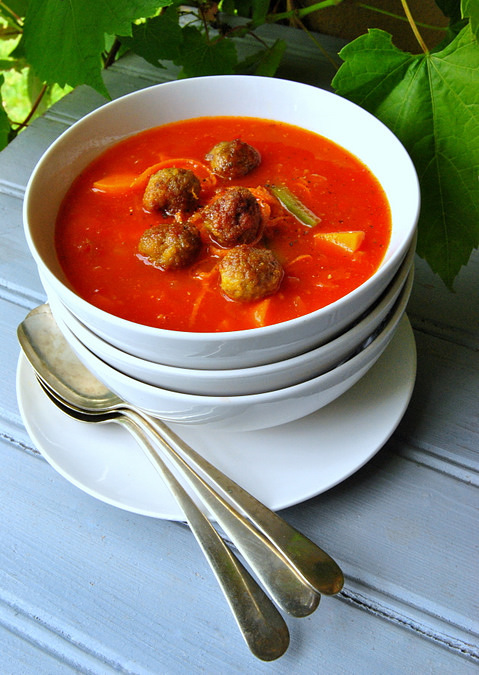
Chakalaka Soup with Little Boerewors Balls
My Chakalaka Soup with Little Boerewors Balls
8
If your soup seems too thick, thin it down with a little hot water, stock or (in the case of creamy white soups) milk. If it’s too watery, put a tablespoon or two of cornflour or flour or arrowroot in a jar, add double the amount of water and shake vigorously until the mixture is smooth. Add this, a dribble at a time, to the simmering soup, stirring constantly, until it reaches the desired thickness.

9
Soup must be served either piping hot or ice cold – there really are no half-measures. Heat the bowls in the oven before you ladle hot soup into them or, if you’re making a cold soup, chill the bowls in a freezer an hour before you dish up. When you're serving guests, don't overfill their bowls: soup is very filling and not everyone fancies downing litres of it at a time.

Beetroot and Gin Shots
My Iced Beetroot and Gin Shots
10
A lovely way of serving soup at a feast is to treat it as a snack course. Halve the quantities given in the recipe, and pour the soup into small, sturdy glasses (or even teacups) that you’ve heated in a gentle oven. Add the toppings specified in the recipe and serve immediately. I often serve vegetable soups as snacks with toasted-cheese fingers: grate some Cheddar or Gruyère over a few slices of toasted bread, cook under a hot grill until bubbling, then dust with paprika or cayenne pepper and slice into strips. Balance a cheese finger across the top of each glass, and provide a few extra for hungry guests.

For more soup recipes from my blog archive, click here.

Print Friendly and PDFPrint Friendly

Friday, 4 November 2011

Chakalaka Soup with Little Boerewors Balls

My upside down, inside-out version of a much-loved traditional dish. Chakalaka is a highly spiced Southern African vegetable relish usually eaten cold as an accompaniment to braaied (barbecued) meat. Here I've reinvented it as a soup bursting with punchy flavours. Topped with juicy mini-meatballs made from the squeezed-out insides of boerewors, this is a dish that will bring tears to the eyes of chakalaka devotees (and more so if you increase the quantity of fresh chillies specified in my recipe).

Chakalaka Soup with Little Boerewors Balls
Chakalaka, said to have been invented by Johannesburg's migrant mine workers, usually includes chillies, peppers and curry spices, plus - depending on who's making it - carrots, beans, cabbage, and so on.

You may be wondering why I've turned a relish into a soup. Well, because I love soup, I really do. Also, I like turning recipes around to see what happens.

This soup is good on its own, but the little spicy meatballs make it special. (I'm  grateful to my friend Nina Timm of My Easy Cooking for showing me how to make instant boerie balls.)

You can leave the baked beans out of the soup, if you like (as I did in the photographs, because I wasn't in the mood for beans) but I recommend including them because they help thicken the soup. If you can't find authentic South African boerewors, use a raw, loose-textured sausage and, before you roll it into balls,  mix in a teaspoon or so of toasted ground coriander, plus some of the spices listed in this recipe.

This is also very good with chopped green beans and cauliflower florets. If you don't have tomato juice, use a tin or two of chopped Italian tomatoes and a little tomato paste instead.

The chickpea flour and spices are used to give the meatballs a nice toasty crust. Chickpea flour, also known as channa flour, is available from spice shops.

Chakalaka Soup with Little Boerewors Balls

3 Tbsp (45 ml) sunflower oil
4 carrots, peeled
3 small green peppers, finely sliced lengthways
4 onions, peeled and finely chopped
1 stick celery, finely chopped
1 green or red chilli, deseeded and finely chopped (or more, to taste)
4 cloves garlic, peeled and crushed
2 Tbsp (30 ml) grated fresh ginger
6 large, ripe tomatoes
4 cups (1 litre) tomato juice (the sort you’d use for a tomato cocktail)
3 cups (750 ml) water or vegetable stock
2 tins baked beans in tomato sauce
2 tsp (10 ml) medium-strength curry powder
1½ tsp (7.5 ml) cumin
salt and milled black pepper
½ cup (125 ml) finely chopped fresh parsley or coriander

For the boerewors balls: 
500 g slim boerewors, or similar sausage
½ cup (125 ml) channa [chickpea] flour
1 tsp (5 ml) paprika
½ tsp (2.5 ml) turmeric

Heat the oil in a large pot. Dice two of the carrots and set the others aside. Fry the diced carrots, pepper slices, onions, celery, chilli, ginger and garlic over a medium-high heat for 8-10 minutes, or until softened but not brown. Roughly chop the tomatoes, place in a blender and pulse to form a rough purée. Pour the purée, the tomato juice and the stock into the pot and cook at a brisk bubble for 30 minutes, skimming off any foam as it rises. Stir in the baked beans, curry powder and cumin, season to taste with salt and pepper and simmer for 20-30 minutes.

For the meatballs, squeeze the boerewors filling from its casing and roll into balls the size of a marble. Combine the channa flour, paprika and turmeric on a plate and lightly roll the balls in the mixture. Fry in hot oil over a medium heat for 4 minutes, or until cooked through. Drain on kitchen paper. Coarsely grate the remaining two carrots. Serve the soup piping hot, topped with hot frikkadels, grated carrot and a shower of parsley.

Serves 8. 


Chakalaka Soup with Little Boerewors Balls


Print Friendly and PDFPrint Friendly

Monday, 9 August 2010

Low-Carb Roasted Ratatouille Soup with Basil Mayonnaise

I'm excited to share my new recipe with you: I think you're going to love it.  It tastes glorious and sunny, like summer in a bowl, and is easy to make (although like all good food it does take time to make). The only part of this recipe that's remotely tricky is the home-made basil mayonnaise, but you can omit this topping if you don't feel confident about making mayo, and the soup will still taste very good without it. Do give the mayonnaise a try, though: it's not anywhere as difficult to make as TV chefs will have you believe.

Ratatouille Soup with Basil Mayo
Low-Carb Roast Ratatouille Soup with Basil Mayonnaise
I'm a devoted fan of ratatouille. Not the watery, chuck-everything-in-a-saucepan-and-stew-to-a-mush variety, but a beautiful meeting of ripe tomatoes, shiny eggplants, snappy courgettes, onions and red peppers, slowly roasted with olive oil and garlic to a silken, jewel-bright deliciousness (try my oven-roasted ratatouille recipe).

As always, the quality of the raw ingredients determines how good the soup will taste. Ripe, plump, vividly coloured vegetables will produce a soup of unrivalled quality, and it is always better the next day, once the flavours have had a chance to mingle and mature.

This recipe serves 6, but is easily doubled. It's low in carbs, excellent if you're on a #LCHF regime, and very suitable for diabetics.


Roasted Ratatouille Soup with Basil Mayonnaise

5 large, ripe tomatoes
2 plump brinjals [aubergines/eggplants], or four smaller ones
2 large, deep-red peppers [capsicums]
8 courgettes [zucchini]
2 large white onions, peeled
½ cup (125 ml) extra-virgin olive oil
flaky sea salt
freshly milled black pepper
6 fat cloves garlic, unpeeled
5 cups (1.25 l) water, plus more for thinning

For the basil mayonnaise:

2 large free-range egg yolks, at room temperature
salt
200 ml vegetable oil (such as sunflower or canola oil)
100 ml extra-virgin olive oil
1 cup (250 ml, loosely packed) fresh basil leaves
1 tsp (5 ml) flaky sea salt
the juice of a large lemon
freshly milled black pepper

Heat the oven to 210 ºC.  Using a sharp knife, top and tail the tomatoes, eggplants, red peppers, courgettes and onions, and cut them into small chunks. Pile all the vegetables into a large roasting pan. Drizzle the olive oil over the vegetables, season generously with salt and pepper and, using your hands, toss well to coat.  Tuck the six unpeeled garlic cloves deep into the vegetable bed (but remember where you've hidden them).

Place the  pan, uncovered, in an oven heated to 210 ºC, and roast for 25-35 minutes, or until the vegetables are beginning to turn golden brown in patches.

Now cover the pan with foil, turn the heat down to 180 ºC, and bake for a further 20-30 minutes, or until the veggies are soft.  Remove the roasting tray from the oven. Fish the whole garlic cloves out of the pan, and set aside.

Pour the water (1.5 l) into the pan, replace the foil, and bake at the same temperature for another 15 minutes.  Remove the pan from the oven and set aside for 15 minutes to cool.

Ratatouille Soup with Basil Mayo
A very thick, pale-yellow mayo
While the vegetables are cooling, make the basil mayonnaise. Put the two egg yolks into a small bowl and add the salt.

Mix the vegetable oil and olive oil in a small jug. Place a damp cloth underneath the bowl so that it doesn't skid around while you're making the mayo.

Using a rotary beater or whisk, beat the egg yolks and salt for a minute. If you don't have such a gadget, use an ordinary wire whisk, and plenty of elbow power. Now, as you whisk the egg yolks with one hand, pick up the jug of oil with the other, and dribble a little splash of oil onto the yolks.  Keep whisking and dribbling, a little splash at a time, with great energy, and within a few minutes you will see the egg mixture begin to thicken rather dramatically.

Keep adding the oil, a dribble at a time, until you have a thick yellow ointment. You may not need to add all the oil: stop adding oil once the mayonnaise has thickened to your liking. (If your mayonnaise doesn't thicken, or it curdles, click here.)  Set the mayonnaise aside.

Roughly chop the basil leaves, and place in a mortar along with the salt. Pound to a rough paste.  (If you don't have a mortar, put the leaves and salt onto a wooden chopping board, and smash them with a rolling pin). Scrape the pounded basil into a little bowl.  Take three of the roast garlic cloves you have set aside and squeeze the soft, baked pulp into the basil mixture. Add the fresh lemon juice and stir well.  Now stir this mixture into the mayonnaise, season to taste with salt and pepper, tip into a clean bowl, and refrigerate.

Tip the contents of the roasting pan into a big bowl, and blitz with a stick blender, or use a food processor or liquidiser to process to a slightly coarse purée.  If the soup mixture seems too thick, or the blades refuse to turn, thin it down with a little boiling water.  Squeeze the pulp of the remaining three cloves of baked garlic into the mixture, season with salt and pepper to taste, and blitz for another minute.

Return the soup to the stove-top and reheat.  Serve your soup piping hot, topped with a dollop of cold basil mayonnaise.

Serves 6. 


Print Friendly and PDFPrint Friendly

Saturday, 19 June 2010

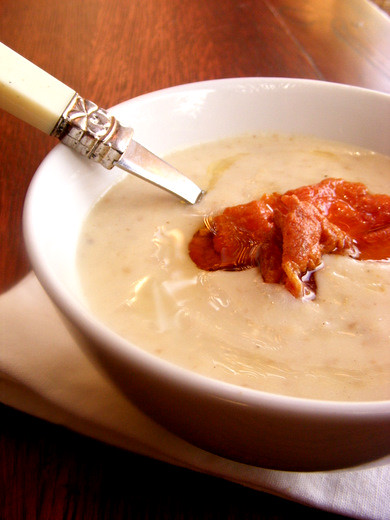
Creamy New-Potato Soup with Frizzled Parma Ham

Creamy New-Potato Soup with Frizzled Parma HamI hardly ever peel a potato these days: first, I can't be bothered. Second, all the finest flavour of a potato lives in its skin, and just underneath it. There are, admittedly, a few dishes that need potatoes to be peeled - good, fluffy, buttery mash and rustling, crunchy roast potatoes are great examples - but I reckon that standing over a sink flaying the skins of potatoes for a stew or slow-cooked casserole  is just madness, and a waste of time.

But a potato soup is a different matter.  I wanted a good, earthy taste to this soup, but I didn't want leathery flecks of potato skin to ruin the texture. The solution was to use some beautiful new potatoes - bought from my local supermarket - which had thin, delicate skins that would disintegrate easily into the blitzed-up soup.

This soup tastes like liquid Pommes Dauphinoise: creamy and soft, with hints of nutmeg and butter.  It's easy and quick to make, but take care not to over-process the soup when you liquidize it, or it may become gluey.  A rich home-made chicken-stock is essential:  a supermarket stock cube or stock powder will not do.  You can make a good stock quite easily from an inexpensive pack of chicken wings and a few vegetables and herbs (here are my tips for making a quick stock; scroll to the end of the post for the recipe).

If you can afford it, do buy a few slices of genuine Parma ham for the top of this soup, from your local deli. It's wildly expensive, I know, but you'll only need six slices, which won't amount to much in cash. If you can't find Parma ham, fry a couple of slices of streaky bacon until they are very crisp, and crumble them over the soup.

Creamy New-Potato Soup with Frizzled Parma Ham

2 T (30 ml) olive oil
2 T (30 ml) butter
2 bay leaves
2 large onions, peeled and chopped
flaky sea salt
30 new [baby] potatoes, wiped
about 4 cups (1 litre) good chicken stock
2 cups (500 ml) whole milk
a big pinch of freshly grated nutmeg
½ cup (125 ml) pouring cream
finely ground white pepper, to taste
flaky sea salt

To serve:
2 tsp (10 ml) vegetable oil
6 slices of Parma ham (or streaky bacon)
a little fruity olive oil

Heat the olive oil and butter in a big pot over a moderate flame.   Add the chopped onions, bay leaves and salt, and fry gently for six or seven minutes, or until the onions are softened and translucent, but not browned.  In the meantime, finely slice the new potatoes, skins and all. Add them to the pot, turn up the heat a little, and cook for three minutes, turning frequently. Now pour in just enough chicken stock to cover the potatoes. Simmer, uncovered, for 30 minutes - top up with a little more stock, if necessary - or until the potatoes are completely tender.  Add the milk and nutmeg, and simmer for five more minutes.  Transfer the mixture to the jug of a liquidizer (or use a stick blender) and blitz until smooth.  If the soup is too thick for the blades to turn freely - this will depend on the potatoes you used - add more hot stock, milk or water to thin it down.  Do not over-process, or the texture will be ruined.  Return the soup to the pot, stir in the cream, season with white pepper and salt, to taste, and gently reheat.

Heat the oil in a frying pan, over a high flame. When the oil is very hot, carefully drape the Parma ham slices over the base of the frying pan. Let them sizzle for 45 seconds, then turn them over. When the ham begins to shrivel and crisp, remove it from the pan and drain on kitchen paper for a few minutes.

Swirl the olive oil over the top of the soup, top with the frizzled ham, and serve piping hot.

Serves 6 Print Friendly and PDFPrint Friendly

Friday, 30 April 2010

Pot-roasted Chicken "Stewp" with Herbs, Garlic and Bacon; and the food blogger's lament

First the chicken, then the lament. I love stews, and I adore soups, so why not a "stewp", I thought? Why not pot-roast whole chickens and vegetables with a lot of liquid, so you end up with fall-apart chicken pieces in a lake of rich aromatic gravy?

Pot-roasted Chicken "Stewp" with Herbs, Garlic and Bacon
Flavoured with wine, garlic and good smoked bacon cubes, this makes an excellent one-dish family meal. There are a couple of steps in this recipe that require a bit of effort: One, pushing some fragrant herby stuffing under the breast skin and, two, browning the chickens on all sides before they go into the oven. After that, all you need do is kick the dish into the oven and forget about it.

Now the moan. (I called it a 'lament' in the title of this post only because I'm trying to cover my dainty behind: recently, in a presentation at the South African Food Bloggers' Conference, I advised bloggers never, ever to complain or whinge in a blog post.)

Anyway: many food bloggers will agree that having to take photographs of food can be  pain in the neck. It's not that styling and photographing your own food isn't fun - it can be hugely rewarding, especially when you've learned a few basic tricks (necessary if you have an elderly camera, as I do), and the winning picture looks just beautiful.

The problem is finding the time - and getting the time of day right.

Here's why: food needs to be photographed in natural light (a flash is the kiss-of-death to a plate of food), and that usually means taking the picture in cool morning light, or at the very least before noon. If you're going to photograph really freshly cooked food, you have to get up early in the morning to cook it. And who has time to do that? Not I, said the little red hen. This blog isn't my job, and my early mornings are gobbled up by school lifts and making of lunch boxes. It's only once I've done a morning's work, and all the afternoon's school lifts and child-admin stuff, that I can hit the kitchen, and by that time the light is too yellow and low-slanting to take a good photograph (the photograph on this page is a good example). So, a few choices: keep some of the food aside to reheat and photograph the next morning, or cook-and-snap on Saturday and Sunday mornings. Neither approach is ideal: the former results in sulky-looking food, and the latter in sulky-looking family members.

And, having said that, I'm actually one of the lucky ones, living as I do in the southern hemisphere where the light is clear and brilliant for most months of the year. At the Food Bloggers' Conference, my pal Jeanne Horak-Druiff of Cooksister! (a South African living in London) had us in stitches as she described her frustration at having to take photographs of her beautiful food on dismal winter evenings. Jeanne set up a special mini-light-box-cum-studio in her conservatory, but was repeatedly defeated by air so arctic that the hot food steamed up her lens.

Why, you may ask, bother to post a photograph at all? Well, the truth is that a food blog without photographs is like a cartoon without illustrations. No matter how original and mouth-watering your recipes, and how brilliant your writing, no one will pay your blog much attention unless it is lavishly illustrated with food photographs. Okay, they don't need to be as perfect as food-magazine pictures (the food-blogging community, competitive as it is, can be very forgiving), but they do, at the very least, need to be sharp, bright and good-looking.

So what's the point of my moan? Nothing, really, except to commiserate with all those other food bloggers who labour in their kitchens to produce excellent recipes, and then decline to post them because they haven't had a chance to take a photograph, or because they took a pic that looks like something the cat sicked up.

If it's any consolation: none of the world's most esteemed food writers take publishable pictures of their own food. I've never seen Gordon, Nigella, Jamie or Nigel with a camera in their hands. They have professional photographers to do this, expert cooks to make the actual dish, and stylists to scatter the parsley and toast the pine nuts. They have home economists to work out the measurements, and editors to tweak the grammar. You, my dears, do this all on your own, and that's what makes your blogs amazing.

On the subject of food photography, please take a look at the work of Nina Timm of My Easy Cooking, who is the reigning queen among South African food bloggers when it comes to photography and food styling. This is the standard of food photography that I aspire to.

But back to the stewp.

This recipe uses two chickens, but you can easily halve the recipe. Do take the trouble to drain off excess fat, as instructed in the recipe, or you will end up with a greasy gravy. You need nice, thick, smoked pork rashers for this dish - watery supermarket bacon will not do. Ask your butcher.

Pot-roasted Chicken "Stewp" with Herbs, Garlic and Bacon

2 large free-range chickens
salt and milled black pepper
a small bunch of mixed fresh herbs of your choice: sage, oregano, basil, parsley and thyme
8 cloves fresh garlic, peeled and finely chopped
the zest and juice of 2 small lemons
6 Tbsp (90 ml) olive oil
6 smoked pork rashers (about 180 g; each about 7 mm thick), cubed
3 onions, peeled and cut vertically into eighths
2 sticks  celery, sliced
24 peeled baby carrots (or 10 medium carrots, peeled and cut in half crossways)
3 Tbsp (45 ml) cake flour
2 cups (500 ml) dry white wine
2 thumb-length sprigs fresh rosemary
8 large potatoes, peeled and halved crossways

Heat the oven to 150°C.  Using the flat of your hand, press down firmly on the breasts of the chickens until you hear the breast bones snap. Season inside and out with salt and black pepper.

Strip the herb leaves from their stalks and chop the leaves fairly finely. Place in a bowl and add the chopped garlic, the lemon zest and 2 Tbsp (30 ml) of the olive oil. Season with salt and pepper and mix well. Now make a 'pocket' at the top of the chickens by very gently separating the breast skin from the flesh: slide your fingertips under the skin on top of the breasts, breaking the fine membrane as you go to create a pouch. Take half of the herb paste and spread it evenly under the breast skin of both chickens (reserve the remaining mixture). Pull the breast skin back into place.

Heat another 2 Tbsp (30 ml) of olive oil over a brisk flame flame in a large ovenproof dish (a big cast-iron pot is ideal; a sturdy roasting pan will also do). Brown the chickens all over in the hot oil, turning frequently: this should take between 12 and 15 minutes. Don't worry if they're not evenly golden brown: what's important is that there's a sticky honey-coloured residue on the bottom of the pan.

Remove the chickens from the pan and set aside. Add the cubed pork rashers to the pan and fry for 3 minutes, or until just crisp and golden brown. Remove from the pan using a slotted spoon and set aside.  Drain all the chicken and bacon fat from the pan, but don't wipe it out.

Put the remaining 2 Tbsp (30 ml) olive oil into the pan, add the onions, celery and carrots and fry over  a medium-high heat for 4-5 minutes, or until the onions begin to colour. Sprinkle the flour over the vegetables and cook for two minutes, stirring. Add the wine and lemon juice to the bowl containing the left-over herb paste, stir well, then pour the mixture over the vegetables, stirring briskly to release any sediment and to prevent lumps forming.  Cook the sauce gently for a two minutes, or until thickened.

Place a sprig of rosemary inside the cavity of each chicken. Rest the chickens, breast-side up, on top of the vegetables in the pan, and arrange the potato halves around them. Using a large spoon, baste the chickens and potatoes with the winy liquid. Cover with a lid, or a tight layer of tin foil, and cook at 150°C for an hour and 45 minutes, or until the potatoes are very tender, and the chicken is falling off the bone. Give the pan a shake now and then, and baste the chicken with the juices. Pull the chicken to joints, and serve immediately, in deep bowls, with hunks of bread.

Serves 8. Print Friendly and PDFPrint Friendly

Friday, 16 April 2010

South African Tomato and Onion Soup with Roast-Garlic and Camembert Toast

Tomato and Onion Soup with Roast-Garlic and Camembert Toasts
Spend any time in South Africa, and sooner or later you'll come across the nation's
favourite sauce: chopped onions and tomatoes, slowly cooked to an unctuous rust-coloured gravy. The sauce is served with mieliepap [maize porridge], with samp and with bread; it's dolloped over sizzling boerewors rolls, served alongside curries and stews, and is an essential side-dish with braaied [barbecued] meat.

 There are as many variations of this sauce in South Africa as there are cooks: some purists insist on just tomatoes, onions, oil and salt and pepper; others add garlic, wine, herbs and spices. Chakalaka, said to have been invented by Johannesburg's migrant mine-workers, is a highly spiced African relish that includes chillies, peppers and curry spices, plus - depending on who's making it - carrots, beans, cabbage, and so on.

I can't enjoy bangers and mash (my last-meal-on-earth dish) without a tomato-and-onion gravy, well thickened with Bisto, because this is they way I ate them as a teenager. I'd arrive home at 4 o' clock, bone-tired and cold, on a Highveld winter afternoon, to find a foil-covered dish of hot Eskort pork bangers and golden-crusted mash in the oven, plus - oh joy! - a saucepan of gloopy gravy on the stovetop.

In its most basic form, a tomato-and-onion sauce is just that: you cook the onions to a melting softness in olive oil or butter, tip in the tomatoes, season with salt and pepper, and cook with a little water or wine until it's ready. I've tried to reproduce the simple, sunny flavours of this sauce in this soup, using only the essential ingredients. The first time I made this soup, frying the ingredients and then diluting them with stock, it was tasty, but lacked body, and had no depth of flavour. The second time round, I lightly caramelised the onions on the stove-top, added the tomatoes and then put the whole lot into the oven to slow-bake for an hour, and this intensifying of the flavours did the trick.

This is a slightly chunky soup, because the tomatoes are not peeled. Peel them if you have to, but it won't taste the same. Please use a good chicken or vegetable stock - see my notes at the end of the recipe - and not a stock cube, which will ruin the clean flavours of this soup .

Tomato and Onion Soup with Roast-Garlic and Camembert Toasts
16 small (plum-sized) onions, or 8 large onions, peeled
3 T (45 ml) olive oil
2 T (30 ml) butter
1 T (15 ml) white sugar
2 T (30 ml) white wine vinegar
16 ripe, juicy tomatoes
salt and milled black pepper
1 litre chicken or vegetable stock
100 ml cream
1 T (15 ml) Tabasco sauce (or more, to taste)

For the toasts:
1 full head of garlic
a baguette, or some rolls, sliced
2 tsp (10 ml) olive oil
1 medium-sized ripe camembert cheese

Pre-heat the oven to 170°C. Peel the onions and cut them in half, vertically (if you're using large onions, cut them into quarters). Heat the oil and butter on your stove-top, in a heavy roasting pan. Add the onions and sugar and fry, over a medium heat, tossing frequently, for four to five minutes, or until the onions are a rich golden colour. Don't allow them to catch or burn. Stir in the vinegar and allow to bubble for a minute. Add the tomatoes, season with salt and pepper, and toss well. Place in the oven and bake for an hour and a quarter, or until the tomatoes have collapsed and the onions are very tender.

Half-way through the cooking time, wrap the whole head of garlic in tin foil, and place it in the oven.

Remove the tray, and the head of garlic, from the oven (don't switch off the oven; turn it up to 200 C). Set the garlic packet aside to cool. Pour the stock over the tomatoes and onions, stirring well to release any sediment. Pour the mixture into a saucepan and purée, using a stick blender (or tip the whole lot into a liquidizer). If the mixture seems too chunky, add a little more stock or water. Gently reheat the soup on your stovetop. Stir in the cream and the Tabasco sauce and adjust the seasoning.

To make the toasts, slice the baguette or rolls and place them, two at a time, in a toaster. Pile the slices on a plate while you prepare the topping. While the bread's toasting, cut off the top of the head of garlic with a pair of sharp scissors or a knife. Squeeze the soft garlic pulp into a little bowl, mash in the olive oil and season with salt and pepper. Cut the Camembert into 5mm slices. Spread each slice with a little mashed garlic, and top with a slice of cheese. Place the slices on a baking sheet and place in the hot oven for a few minutes, or until the cheese has melted and is bubbling.

Serve the soup piping hot, with the cheesy toast.

Serves 6.

Note about stock:  The difference between a nice soup and a truly delicious one is the stock, so here's how to make a quick, easy, inexpensive chicken stock (if you're a vegetarian, here is a recipe for a good vegetable stock).   Buy a packet of chicken wings, which usually come in sixes or eights.  If your supermarket doesn't have them, ask the butcher for a chicken carcass.  Place the wings or carcass in a saucepan and cover with a litre of cold water.  Add any or all of the following flavourings: two carrots, a halved onion, a stick of celery, a few stalks of parsley,  a chopped tomato, a handful of mushrooms, a bay leaf, two whole cloves, a sprig of thyme and six peppercorns.  Bring slowly to the boil.  Turn down the heat and allow to simmer for an hour,  skimming off any grey scum as it rises. Strain through a colander into a bowl, and use, as directed, in the recipe. Print Friendly and PDFPrint Friendly

Thursday, 18 June 2009

Spicy Chicken, Tomato and Sweetcorn Soup

This is a versatile, nourishing recipe for a family with picky eaters (and another idea for a double dinner).

If your kids don't like spicy or strong flavours, or 'floaty bits', leave out the chilli, the pepper, the cayenne pepper, the cumin and the paprika. When the soup's ready, put half of it into a blender, blitz until thick and smooth, and serve topped with grated cheese and crunchy little croutons.

To the other half, add all the zingy ingredients you left out (but half the quantity specified below) and simmer for a further 10 minutes.

I usually use tinned, drained sweetcorn kernels (not the creamed variety) because they are so convenient, but you could as easily use frozen kernels, or fresh ones cut from the cob.

Spicy Chicken, Tomato and Sweetcorn Soup

For the stock:
1 whole free-range chicken, trimmed of excess fat
3 ripe tomatoes, chopped
1 onion, peeled and roughly chopped
1 carrot, peeled and roughly chopped
a few stalks of parsley
a stalk of celery
a large bay leaf
a few peppercorns
2 whole cloves
enough cold water to cover (about 2 litres)

Place all the ingredients for the stock into a big pot and cover with cold water. Bring to the boil, then turn down the and simmer gently for an hour and a half, skimming any foam that rises to the top. Remove the chicken and set aside to cool. Strain the stock into a large bowl and discard the flavourings. When the chicken has cooled, pull the cooked flesh from the bones, discarding any fat or skin. Tear it into small shreds with your fingers, cover and set aside. At this point you can, if you are planning ahead, put both the stock and the chicken shreds into the fridge for a few hours, or overnight.

For the soup:
3 tablespoons (45 ml) olive oil
1 large onion, peeled and finely chopped
2 sticks celery, finely chopped
2 carrots, peeled and diced
3 cloves garlic, peeled and crushed
2 large potatoes, peeled and diced into 1-cm cubes
1 red chilli, finely minced [optional]
1 tin Italian tomatoes, chopped
3 tablespoons (45 ml) tomato paste
2 cups (500 ml) corn kernels (frozen, tinned or fresh)
1 cup (250 ml) split orange lentils
3 teaspoons (15 ml) ground cumin
1 teaspoon (5 ml) sweet paprika
1 teaspoon (5 ml) cayenne pepper or chilli powder, to taste
2 teaspoons (10 ml) dried oregano
salt and milled black pepper
a handful of fresh chopped parsley, or fresh coriander

To serve:
chopped spring onions
sour cream or plain Greek yoghurt

Heat the olive oil in a large pot. Add the onion, celery, carrots, garlic, potato cubes and chilli and fry over a medium heat for five minutes. Remove any fat from the top of the cooled stock, and pour the stock over the vegetables. Bring to the boil. Add all the remaining soup ingredients and season well.

Turn down the heat and simmer for 45 minutes to an hour, or until the lentils are cooked through and the potato pieces are quite tender. Tip in the shredded chicken. Cook gently for a further ten minutes. Check the seasoning, stir in the chopped parsley and serve at once, topped with chopped spring onions and a blob of sour cream or yoghurt.

Serves 6 Print Friendly and PDFPrint Friendly

Monday, 12 January 2009

Blend-Ahead, Deeply Delicious Spicy Mince, Bean and Tomato Soup

Blend-Ahead, Deeply Delicious Spicy Mince,  Bean and Tomato Soup
Blend-Ahead, Deeply Delicious Spicy Mince, Bean and Tomato Soup
This is a great recipe for feeding a hungry horde of teens on a shoestring, because it uses only 500 g of lean mince and is thickened with nutritious (but cunningly concealed) tinned beans, which are the perfect fibre and energy food for teens.

If you're a vegetarian, leave out the mince - it's just as good without it. It's called Blend-Ahead because it's puréed before it's cooked.

There are a lot of ingredients, and a longish cooking time, but the soup takes less than 15 minutes to prepare. Oh, and did I mention that it is delicious and addictive? I've made it three times this week.


Blend-Ahead Spicy Mince, Bean and Tomato Soup

2 Tbsp (30 ml) vegetable oil
3 onions, peeled and roughly chopped
500 g lean minced beef
6 large, ripe tomatoes, roughly chopped
1 tin good tinned tomatoes, and their juice
3 cloves fresh garlic, peeled and roughly chopped
1 tin butter or kidney beans, and their liquid (see notes)
1 tin baked beans in tomato sauce
2 Tbsp (30 ml) mild curry powder
2 Tbsp (30 ml) powdered cumin
1 Tbsp (15 ml) powdered coriander
1 tsp (5 ml) Tabasco sauce
1 tsp (5 ml) chilli powder [optional; to taste]
4 Tbsp (60 ml) tomato sauce [ketchup] or 30 ml (2 Tbsp) tomato paste
1.25 litres (5 cups) vegetable stock, chicken stock or water
salt and freshly ground black pepper
200 ml coconut milk

To serve:
a dollop of plain white yoghurt, chopped coriander and a few dabs of olive oil, plus anything else you fancy: grated cheddar, chopped spring onions, fresh green chillies, etc.

Heat the oil in a large saucepan. Put the onions in the goblet of a liquidizer fitted with a metal blade and whiz until very finely chopped. Fry the onions in the oil until they are softened and beginning to turn golden.

Turn up the heat and add the mince, stirring with a fork to break up any lumps. While the mince is browning, put the tomatoes, the tin of tomatoes, the garlic and the tinned beans and their liquid into the liquidiser. Process until fine.

Tip the cooked mince and onions into a metal sieve set over a bowl and press down with a fork to drain off excess fat. Now tip them back into the pot and add the ingredients you've just liquidised. Add all the remaining ingredients, except for the coconut milk, and use a balloon whisk to combine everything and break up any stubborn lumps of beef.

Bring to the boil, and then immediately turn down the heat. Cook over a moderate to low heat for about an hour and a half, stirring now and then to prevent sticking, and skimming off the foam as it rises. If the soup seems too thick, add a little more stock or water to thin it down. It's important not to rush the cooking: the beef should melt into tender granules and the soup needs time to thicken. Stir in the coconut milk and serve very hot, with the cool and crunchy toppings.

Serves eight.

Cook's Notes:

- Any tinned bean and its juice will do, but this is my favourite combination
- Add a tin of sweetcorn kernels or chickpeas, or lentils, if you'd like to add even more bulk.
- You can use an equal quantity of tinned tomatoes instead of fresh ones, but the flavour somehow isn't the same.
- You can also use dried beans in this recipe, but you will need to soak them and boil them in advance. Remember not to add any salt to the boiling water, which will toughen the beans.

Print Friendly and PDFPrint Friendly

Friday, 11 April 2008

Quick, thick chicken soup for kids, using the remains of the roast

My goodness, but it's a palaver making a proper chicken soup. The concocting of the stock, the cooling of the bird, the plucking of the meat, the chopping and frying of the onions and other veg, the liquidising-in-batches of scalding liquid, and the dozens of dirty bowls, pots and sieves involved ... it just doesn't seem worth the bother, no matter how heavenly and heartwarming the result.

But I feel I have an obligation to make chicken soup for my family, the same creamy, thick, luscious, nutmeggy essence of chicken made by my own mom and her mom before her. Besides, it took me eight years to convince my daughter to eat soup, and Mom's Chicken Soup is the only soup she'll eat. Every time I put a picked-out chicken carcass on the stove to make a stock (which is generally once a week) she races into the kitchen, shouting 'Oh, goody! Chicken soup!'.

Here is a quicker version that omits the tiresome chopping and sautéing of veggies, and involves only a large saucepan, a colander, a big bowl and a liquidiser. It doesn't have the complex flavours of a properly made chicken soup, and it's thickened, I blush to admit, with flour, but I promise this is a passable version of the real thing.

Quick, thick chicken soup for kids

the leftovers of a roast chicken, excess skin and fat removed
1 large onion, peeled and cut in half
3 large carrots, peeled
a few sticks of celery, or a handful of fresh parsley, or both
2 bay leaves
5 black peppercorns
water
4 Tbsp (60ml) flour
4 Tbsp (60 ml) butter
1½ cups (375 ml) milk
juice of half a lemon
½ tsp (2.5 ml) freshly grated nutmeg
salt and milled black pepper
a dash of fresh cream (optional)

Put the chicken, onions, carrots, celery, parsley, bay leaves and peppercorns in a large saucepan, add just enough water to cover the ingredients, and bring to the boil. Reduce the heat and simmer over a gentle heat for an hour and a half, or until the stock has reduced slightly. Place a colander in a large bowl and tip the stock, bones and vegetables into the colander. Allow to drain for five minutes.

In the meantime, make a white sauce. Heat the flour and butter in the same saucepan in which you made the stock. Allow to bubble for a minute or so. Using a balloon whisk, whisk in the milk and continue stirring briskly until the mixture begins to thicken alarmingly. Immediately remove from the heat.

Now tip half the drained stock into a liquidiser and add the cooked onion, celery, parsley and carrots. Give it a good whizz to process everything finely, then pour the mixture into the milk/flour mixture. Return to the heat and bring to the boil, whisking constantly to disperse any lumps. Once the mixture is thickened and boiling, use the left-over stock to thin the soup to the desired consistency. Pick all the remaining bits and pieces off the boiled chicken, shred with your fingers and add to the soup. Add the lemon juice and a shower of nutmeg, and season well with salt and pepper. Add a splash of cream, if you like (but this isn't really necessary - the soup is quite silken enough without cream). Simmer for another 5 minutes, and serve hot.

Note: The final thickness of any white sauce depends on the strength of the flour. If you find your soup isn't quite thick enough, add a little flour or cornflour slaked with water.

Print Friendly and PDFPrint Friendly