Showing posts with label Cape Town. Show all posts

Monday, 25 March 2013

Cape Pickled Fish with Lime, Thyme & White Pepper, and a Pickled-Fish Paté, from the left-overs

I suppose one shouldn't tinker with a traditional South African recipe that has such a long and noble pedigree, but I thought I'd introduce some zing and freshness to my pickled fish this Easter.  I've given my 2010 recipe for Extra-Lemony Cape-Malay-Style Pickled Fish a kick in the pants with fresh lime juice, lemon thyme and plenty of white pepper, and I'm pleased with the result.


Thickly sliced onions add punch and crunch to my lighter version of pickled fish.

Pickled fish is lovely with buttered brown bread.

The next time I make this (this week, hopefully, in time for the Easter weekend) I'm going to try using only Thai flavours for the marinade, because I think a sweet-sour-salty-hot pickle with plenty of fresh coriander, lemon grass and green chilli may be an irresistible combination. Further down in this post, you'll also find a recipe for a deliciously buttery, mildly spiced dip using pickled-fish left-overs: I made a few pots of this paté this week, using the leftovers no-one in my family wanted, and it was eagerly devoured by my guests on Saturday night.

South African Cape Malay Pickled Fish
Some of the ingredients for my pickled fish. Limes, fresh lemon leaves and lemon thyme add a
lovely citrussy flavour, and I've added mustard seeds for extra bite.

I still can't figure out, three years after I wrote about South African pickled fish on this blog, how this old recipe has come to be associated with Easter in Cape Town. One of my Facebook friends, Helen Brain, advanced her theory:  'I suspect that it has to do with Good Friday church services, which take three hours. You don't have time to cook after that, so pickling the fish means that when you come home from church at 12, lunch is ready.'  That seems plausible, but it still doesn't explain how this dish, indisputably a classic of Cape-Malay cuisine, is so eagerly looked forward to by Islamic families in the Cape during the Christian holidays of Eastertide.  If you have any insights or inklings about this, please post them in a comment below!

 Don't slice the onions too finely, or fry them too long - they should retain a good crunch.
In this recipe, the ginger and garlic are very briefly cooked, as are the other spices, so that the pickling liquid is fresh and zesty. If you can't find lemon thyme, use some roughly chopped lemon grass instead.

Cape Pickled Fish with Lime, Thyme & White Pepper

For the fish:
1 kg firm-fleshed white fish, such as yellowtail or snoek, skin on
½ cup (125 ml) cornflour, for dusting
salt and white pepper
3 Tbsp (45 ml) sunflower or canola oil

For the pickle:
3 Tbsp (45 ml) sunflower or canola oil
3 onions, peeled and sliced into rings (not too finely)
3 cloves garlic, peeled and finely chopped
a thumb-size piece of ginger, peeled and finely grated
4 tsp (20 ml) black mustard seeds
12 black peppercorns
3 whole white cardamom pods
1 red chilli, deseeded and finely chopped [optional]
3 bay leaves
2 Tbsp (30 ml) sugar
4 Tbsp (60 ml) rice vinegar (or white wine vinegar)
2 tsp (10 ml)  turmeric
1½ tsp (7.5 ml) white pepper
2 tsp (10 ml) cumin
2 tsp (10 ml) mild curry powder
1 tsp (5 ml) salt
the juice of 4 limes (or 3 lemons, if you can't find limes)
1 tsp (5 ml) finely grated lime (or lemon) zest
a few large sprigs of lemon thyme
1 cup (250 ml ml) water

To top:
extra sprigs of fresh lemon thyme, and fresh lemon leaves

Cut the fish into portions each about the size of a deck of cards. Put the cornflour on a plate and season with salt and a little white pepper. Press the fish pieces into the cornflour, top and bottom, then shake them energetically to remove the excess. Heat the 3 Tbsp of oil in a pan over a medium-high heat, and when it is good and hot, fry the fish pieces, in batches, for 2-3 minutes on each side (depending on how thick the pieces are) or until golden brown and just cooked through. Take care not to over-cook the fish, or it will dry out. Remove from the heat and set aside on a plate.

Now make the pickling mixture. Wipe the pan clean of oil and residue using a piece of kitchen paper.  Heat 2 Tbsp of sunflower or canola oil in the pan, over a medium-high flame. When the oil's hot, add the onion rings, and fry, stirring now and then, for 2 minutes, but no longer (it's important that the onions retain their crunch). Stir in the garlic and ginger and cook for another minute, without letting the garlic brown. Scrape the onions, garlic and ginger into a bowl and set aside.

Heat the remaining tablespoon of oil over a medium-high heat in the same pan and add the mustard seeds, peppercorns, cardamom pods and red chilli [optional]. When the mustard seeds begin to crackle, add the bay leaves, sugar and vinegar. Bring to the boil, then stir in the turmeric, white pepper, cumin, curry powder, salt and half a cup (125 ml) water. Cook the mixture for 2-3 minutes at an energetic bubble, or it has thickened slightly and the strong vinegar flavour has dissipated. Stir in the lime juice and zest, the lemon thyme sprigs, the remaining half-cup (125 ml) of water and the reserved onion/garlic/ginger mixture.

Simmer gently for another minute and then remove from the heat.

Tip half of this mixture into the bottom of a ceramic or plastic dish just big enough to hold all the fish in a single layer. Pour the remaining mixture on top, making sure every piece of fish is well coated with the pickling liquid. Top with a few extra sprigs of lemon thyme, plus some fresh lemon leaves, if you can find these. Cover the dish tightly with clingfilm or a lid, and refrigerate for at least 12 hours - preferably 24 - turning the fish now and then in its pickle.

Serve cold, with buttered brown bread, and perhaps some cold crunchy salads, or warm boiled potatoes.

This mixture keeps well in the fridge for up to a week.

Serves 6-8 as a snack.


And here's what to make with the leftovers. If you don't have a small jug attachment for your stick blender, you can pound everything together to a paste using a mortar and pestle, or use a food processor fitted with a metal blade (although you might need to double the quantities if your food processor is a big one).

Cape Pickled Fish Paté

1 cup (250 ml, fairly tightly packed) flaked pickled fish
4 Tbsp (60 ml) butter, softened
¼ cup (60 ml) roughly chopped onion rings, taken from the pickle
1 Tbsp (15 ml) pickling liquid, from your pickled fish
1 Tbsp (15 ml) olive oil
the juice of a small lemon
½ tsp (2.5 ml) Tabasco sauce, to taste
3 Tbsp (45 ml) fresh coriander leaves
salt and milled black pepper


Make sure you've removed every bone and scrap of skin from the flaked fish.  Put the fish into the jug attachment of a stick blender, or into a liquidiser.  Add the onion rings, pickling liquid, olive oil, lemon juice and Tabasco sauce, and whizz the mixture to a fairly homogenous yet slightly chunky paste. If the mixture is too thick for the blades to turn freely, add a little more of the pickling liquid, or some water.

Now add the coriander leaves and press the pulse button a few times so the leaves are fairly coarsely chopped through the mixture,but not pulverized (which will turn the paste green).  Season to taste with salt and pepper, and add a little more lemon and Tabasco sauce if the mixture needs a little more sparkle.

Scrape into a bowl, cover with clingfilm and refrigerate for an hour or two, until just firm. Serve with hot toast or crackers.

Serves 4-6 as a snack

Print Friendly and PDFPrint Friendly

Tuesday, 10 May 2011

Audrey's Cape Brandy Tart

A rich, boozy, classic of Cape cookery that will warm the heart of anyone who appreciates warm, cakey puddings. This recipe was given to me by my late mother-in-law (an excellent baker) some twenty years ago, just after I was married, and I've made it countless times since.

Audrey's Cape Brandy Tart
Boozy Cape Brandy Pudding, with thick cream
It's one of those faultless recipes that should be framed in gold and hung on a wall: it always works, it's fairly easy to make, and everyone loves it - even kids! Look, I'm not advocating that kids binge on the stuff, but don't worry about them eating a small slice. Because the brandy sauce is poured over a very hot cake, much of the alcohol content evaporates.

I think Cape Brandy Tart is best with whipped cream, but like all hot cakey puds is also lovely with custard or ice cream, or both. This recipe serves six hungry people, but is easily doubled (and in fact, I recommend you make more, because it reheats very well). If you like, you can add some chopped pecan nuts to the mix, but I prefer this without nuts.


Audrey's Cape Brandy Tart
one 250 g block of pressed dates
1 tsp (5 ml) bicarbonate of soda [baking soda]
1 cup (250 ml) boiling water
120 g butter, softened
1 cup (250 ml) caster sugar
1 extra-large egg
1¼ cups (310 ml) flour
a pinch of salt
½ tsp (2.5 ml) baking powder

For the syrup:
½ cup (125 ml) water
½ cup (125 ml) brown sugar
¾ cup (190 ml) brandy
2 Tbsp (30 ml) butter
1 tsp (5 ml) vanilla extract

Heat the oven to 180ºC. Chop the dates, quite coarsely, using a heavy knife, and place them in a bowl. Sprinkle the bicarbonate of soda over the dates and pour over the boiling water. Set aside to cool slightly. Put the butter and sugar into a large bowl and, using an electric whisk (or a normal whisk and a lot of elbow power), cream together until pale, light and fluffy. Break the egg into one side of the bowl and gradually incorporate it into the butter/sugar mixture. Beat for another minute. Take your time over getting a really light, fluffy mixture.

Sift the flour, salt and baking powder into the mixture (hold the sieve up high, so the dry ingredients fall from a height; this helps to aerate the flour). Add the warm date/water mixture and very gently fold everything together. Pour the mixture into a deep 22-cm buttered ceramic or glass pie dish. Bake at 180 ºC for 30-40 minutes, or until the cake is well risen, dark-brown and cooked right through.

Ten minutes before the cake is ready, make the syrup.  Put the water and brown sugar in a saucepan and bring gently to the boil, stirring frequently  to dissolve the sugar crystals. When the syrup is clear, remove from the heat and stir in the brandy, butter and vanilla extract.

Remove the cake from the oven. Pour the hot syrup, in batches, over the hot cake, tipping the dish so that it sinks in evenly.  The syrup will bubble furiously at the edges of the dish.

Serve warm, with whipped cream.

Serves 6-8. Print Friendly and PDFPrint Friendly

Sunday, 14 November 2010

A food bloggers' master class in Cape Town, with chef Neill Anthony

Master Class Cape Town, with chef Neill Anthony
You meet a lot of interesting people on Twitter, but you don't always have the chance to meet them in real life. When I 'met' Neill Anthony recently and learned that this talented young chef, who trained in kitchens of Gordon Ramsay, Marcus Wareing and others, was making waves as a personal chef Cape Town, I wasted no time in putting him in an elbow-lock (virtually speaking, of course) and tweaking his ears until he agreed to present a master class for local food bloggers.

Not that he needed much tweaking.  Neill was enthusiastic about the idea from the beginning, and together we planned a class that would challenge and inspire people who were keen to pick up top tips from some of England's finest kitchens. I didn't want any ordinary cooking demo - most of the best food bloggers and home cooks have long since mastered the basics, and beyond - but rather a class that would help already-competent cooks hone their skills and sharpen their recipes.

Master Class Cape Town, with chef Neill Anthony
We were not disappointed. What I found so fascinating about watching Neill at work was his precision, his concentration, and his razor-sharp attention to detail.  He has the lightest, nimblest fingers, and his work space is as clean and shining as an operating table.  (A bit of an eye-opener for me, the world's messiest cook.)

And the food? Well, it was heavenly. What really opened my eyes was how Neill created such beautiful, clean-flavoured dishes using so few ingredients.  And I mean really few ingredients: I shopped for the event, and I kept having to check and recheck my shopping list because the trolley seemed so empty.

Master Class Cape Town, with chef Neill Anthony
After the demo, we all sat down to enjoy a beautiful three-course meal, with wines that Neill had bought along from Silverhurst. He also bought a big bottle of award-winning Willow Creek olive oil for each attendee (thanks, Willow Creek and Silverhurst!).

On the menu, hand-made ravioli and tortellini with a baby spinach, ricotta and liquid egg-yolk filling, served with a butternut purée and an onion and milk froth; Norwegian salmon with baby beetroot, and whole white beans and puréed beans with tarragon; and a boozy prune and brandy soufflé.

But I'll let the images tell the story. Below, you'll find some lovely pictures from the demo, taken by Barry White, a professional photographer, who - following instructions from his wife and boss, my dear friend Judy Levy - kindly tolerated us invading the White/Levy household.  Judy and Barry have agreed to host future master classes at their beautiful home in Oranjezicht over the coming months. (Watch this space for details, or send me an email if you'd like to be on my mailing list: hobray at gmail.com.)

We're planning to hold similar master classes once a month, featuring Cape Town's top chefs. We'll also be inviting artisanal  food producers to showcase their wares and demonstrate their recipes. (And another thank you to Verlaque Fine Foods, who gave us some beautiful bottles of their brilliantly flavoursome 'Splashes', balsamic reductions and preserves, and Sam Linsell of The Smoking Shed, who handed out samples of her fantastic smoked wares, which include an ethereal cold-smoked tuna; deliciously crunchy cashews and macadamias;  and - for everyone to take home -  blocks of cold-smoked butter and little packets of smoked sea salt.)

Master Class Cape Town, with chef Neill Anthony

Master Class Cape Town, with chef Neill Anthony

Master Class Cape Town, with chef Neill Anthony

Disclosure: Verlaque Fine Foods, who provided product give-aways for this demo, is one of of my clients. Print Friendly and PDFPrint Friendly

Friday, 14 May 2010

Good Food & Wine Show: the good, the bad, and the Gordon

I never miss a Gordon Ramsay show on TV if I can possibly help it, so there was no way I was going to miss the opportunity to see the world's most famous chef in action at Cape Town's Good Food and Wine Show. At R750 (about $100), the 'VIP' tickets were staggeringly expensive, but my husband surprised me by presenting me with one as my early birthday present.

Ever since I read Ramsay's fascinating autobiography, Humble Pie, a few years ago, I have greatly admired him, and have followed his career with interest. Yes, I know he swears like a sailor and can be unspeakably rude to colleagues, minions and foes, but I dig Gordon anyway. Not only because he's knee-wateringly sexy (let's get that one out of the way, shall we?) but also because he's tenacious, talented, kind-hearted, hard-working and -  most important of all -  utterly fearless.

Fearlessness is a quality I desperately admire in people who have it. I'm not a fearful person (fearlessness is not the opposite of fearful) but I would love to have total conviction, and an unswerving faith, in my own abilities. 'Only with absolute fearlessness can we slay the dragons of mediocrity that invade our gardens,' design icon George Lois once said, and that is a sentiment that rings very true for me. I would also love to have big enough balls to tell annoying people to fuck right off (I am getting better at this, the older I become).

It's Ramsay's loathing of mediocrity that is his greatest asset, and I have no doubt that this is why he has become, in the culinary world at least, a global super-star.  Both my teenage sons (who usually read only encyclopaedic fantasy epics) raced through Humble Pie and regularly watch his shows with relish and a lot of guffawing. I heartily endorse their admiration of Ramsay because I would like them, both kind-hearted and clever boys, to be fearless in their adult lives.

So, that's why I wanted to see the man in action.  And his show this morning was great: he was funny, warm and polite.  But, my goodness, he had to work hard to get a belly laugh out of a rather subdued Cape Town audience.  Half his rude jokes went right over their heads, and when he asked how the audience liked the T-shirt he was wearing (our national soccer team's official jersey) he raised - disgracefully - only a feeble cheer from a mostly pale-skinned housewifely audience.

I wasn't blown away by Ramsay's humdrum choice of demo dishes - a potato-and-haddock soup, sticky chicken and tarte tatin - and would have loved to have seen him demonstrate something more edgy and challenging, and something we haven't seen made on TV a hundred times.  But this was a minor disappointment, compared to what came next.

When the show ended, we VIP-ticket-holders were told to stay in our seats, while the rest of the audience - the cheap seats - filed out.  Oh, goody, I thought.  Now for the expensive part of our tickets!  What would this be?  Another short demo? A Q&A session?  Perhaps - gasp - a free stream of expletives?  But it turned out that we were held back in class only to receive our  'free', pre-signed copies of Ramsay's book Easy.  By the time we got outside, the queue for book-signing queue was 150 deep.  At this point, I wandered away to sample a few goodies at the nearby stalls.  When I rejoined the queue, some time later, I stood patiently in line and eventually found myself in a band of infuriated VIP ticket holders who'd been told they couldn't meet Ramsay, or have their books personalised, because they were 'too far behind' in the queue.  The security guards were heckled, feet were stamped, fists were shook and I enthusiastically joined the fracas, because I wanted to ask Ramsay to sign my copy of Humble Pie. Eventually some organiser or manager pitched up, reluctantly peeled her cell phone away from her ear, and snottily told the people who'd parted with R750 to 'calm down'.  Standing next to a sign saying 'VIP Book Signings' she said, without a trace of irony, 'You got what you paid for'.

The long and the short of it?  If you'd bought a cheap seat (and let this be a lesson to me my husband) you got the long end of the stick, and a face-to-face meeting with His Ramsayness. If you were rattling your jewellery in the prime seats, you got a poke in the eye.

But what of the rest of the show?  I don't mean to sound like a grumbler, but I am always disappointed by big food events like these, because of the dearth of really interesting, innovative food producers. I see that my sentiments are shared by my fellow blogger, Sam of Drizzle and Dip, who posted this about the event.

I'm not interested in stalls peddling knives, gimmicky vegetable turners and expensive casserole dishes, and I cannot understand why bath salts, soaps and crappy powdered stocks are featured at a good food show.  There is always a surfeit of stalls selling olives, olive oil, tapenade, chilli sauces and pickles, and never enough emphasis on small producers of excellent artisanal cheeses, sausages, breads and the like.

Having said that, there were a few stalls that really stood out for me, and I came back with two bags laden with some outstanding local produce.

Though I'm not mad about bottled sauces, I have to applaud Pesto Princess for their delicious, knock-your-socks-off pastes and pestos.  One of the best products in this show, in my opinion, is Pesto Princess's gorgeous fresh Chimichurri, a zingy Argentinian paste of coriander, parsley, chilli, garlic and lemon.  Their fresh chermoula and berebere pastes are as fresh, sparky and delicious, I bet, as anything you'll taste in Morocco or Ethiopia.   In second place is an exceptional, award-winning hand-made camembert by La Petite France. With its velvety skin, melting texture and exquisite creaminess and flavour, this is a cheese worth lying under a train for.  I also bought a side of a most beautiful and delicate smoked trout from Harty's of Somerset West, and several packs of excellent home-made sausages -  Toulouse, Swedish, Chourico and a devilish 'Diablo' -  from Rudi's of Gordon's Bay. And I was delighted to see tasty, tender pork neck on sale at the Ranch Meat Centres stall. I've been hunting for a good supplier of pork neck since I moved to Cape Town, spurred by the fact that recipes for pork neck are by far and away the most visited pages on this site.

I wish I could give you details for all these producers, but most of them are so small that they don't have websites.  The official website for this show doesn't list suppliers' details (the dragons of mediocrity have invaded that garden) but I did collect some cards, and will happily send you email contact details for these suppliers if you want them.  (I'm not going to post them here, for fear of their email addresses being harvested and spammed). My email address is hobray at gmail dot com.

PS I did request an interview with Ramsay, but all the slots were taken.  The invitation to the media briefing, promised to me by the reigning pee-ar, never arrived.  Those pesky dragons again.

POSTSCRIPT: I see that visitors who paid big money to attend the Gordon Ramsay event at his Maze restaurant were also upset.  Read the organisers' response, and comments from readers. Print Friendly and PDFPrint Friendly

Tuesday, 11 May 2010

Cape-Malay-Style Curried Lamb Kebabs with Apricots

A sosatie (so-sar-tee) is what South Africans call the full-size version of this succulent and highly spiced lamb or mutton kebab.

Drenched in a turmeric-yellow, sharp-sweet marinade, sosaties of this sort are usually threaded with chunks of raw onion, dried fruit and fresh bay or lemon leaves; traditionally they contained chunks of sheep fat, which helped keep the meat juicy.

My bite-sized version contains little fat, and the lamb is tenderised by a long marinating time and a small amount of plain yoghurt.

Welcome to the third in my series of delicious, easy football snacks with a South African flavour.

This is the sort of recipe that can bring tears to the eyes of a South African living away from home, so evocative is it of the lazy, woodsmoky scent of a traditional braai [barbeque].  This is one of the classics of South African cuisine, and is certainly - along with bobotie - the best-known of all Cape Malay dishes.

Some claim that the name 'sosatie' is derived from a combination of the words 'saus' [sauce] and 'sate', but the authoritative Dictionary of South African English on Historical Principles tells me that the Afrikaans/Dutch name 'sasaatje' comes from the Javanese word 'sesate', which means 'meat on skewers'.

The word first appeared in print, says the dictionary, in 1833.  So popular were these kebabs in the early days of the Cape, says that wonderful raconteur Lawrence Green in his book Tavern of the Seas, that many of the taverns of old Cape Town were known as 'Sosatie and Rice houses'.

Hildagonda Duckitt's "Where is it?" of Recipes, first published in 1891, gives a recipe for 'sasaties or kabobs' that does not differ substantially from a sosatie you might be offered at a family braai today, 120 years later.  As is the case with any hallowed recipe, every cook has his or her own closely guarded formula.

Sosaties are always cooked over hot coals. If you don't have access to a barbeque, you can cook them under a fiercely hot preheated oven grill. For an authentic taste, put the meat very close to the grill at first so that the edges of the meat and fruit just begin to catch and blacken. Then move the sosaties to the middle of the oven, turn down the heat and bake until the lamb is cooked through.

If you can't find lemon or orange leaves, use bay leaves (but citrus leaves are best, as they infuse the lamb with a wonderful perfume as it cooks). Ask your butcher for lamb from the leg or shoulder, or for some nice fatty mutton, if he has it.  You can add petals of raw onion to these kebabs, but be warned that they will retain a bit of raw crunch.

You will find all the ingredients below in a good spice shop.

Cape-Malay Style Curried Lamb Kebabs with Apricots

750 g lamb from the leg or shoulder, cut into large cubes
fresh lemon or orange leaves
24 dried apricots
melted butter for brushing

For the marinade:
40 g dried tamarind pulp
1 cup (250 ml) boiling water
4 Tbsp (60 ml) vegetable oil
2 onions, peeled and very finely chopped
3 cardamom pods
1 thumb-length quill of cinnamon
1 red chilli, seeds removed and finely chopped
2 Tbsp (30 ml) grated fresh ginger
3 cloves garlic, peeled and finely chopped
1½ tsp (7.5 ml) ground cumin
1 tsp (5 ml) ground coriander
1 tsp (5 ml) red chilli powder
3 Tbsp (45 ml) white wine vinegar
80 ml thick fruit chutney (Mrs Ball's Original, if you can find it)
2 Tbsp (30 ml) sugar
2 tsp (10 ml) mild curry powder
1½ tsp (7.5 ml) turmeric
½ cup (125 ml) water
salt and milled black pepper
the juice of half a lemon
½ cup (125 ml) plain white yoghurt

Put the tamarind in a small bowl and cover it with the boiling water. Set aside. Heat the oil in a pan and add the cardamom pods, cinnamon stick and onion. Cook, over a brisk heat, for 5 minutes, or until the onions take on a golden colour.

Add the chilli, ginger and garlic and cook for another minute or so, without allowing the garlic to brown. Stir in the cumin, coriander and chilli powder and allow to sizzle or two minutes, or until you have a rich golden paste. Now add the vinegar and chutney, turn down the heat and allow to bubble for three minutes.

Using your fingers, break up the tamarind pulp in the water. Tip the lot into a sieve set over a bowl, pressing down on the pulp to extract the juice. Discard the pulp. Pour the tamarind water into the pan and add the sugar, curry powder, turmeric and water.  Season with salt and pepper and simmer for 15 minutes.  Remove from the heat and allow to cool slightly.  Stir in the lemon juice and yoghurt.

Tip the marinade into a deep plastic or ceramic dish and add the lamb cubes. Stir well to coat, cover and place in the fridge for at least 24 hours, or longer if possible (you can make these three or four days in advance).

Pour some boiling water over the apricots and allow to soak for 5 minutes. Drain and set aside. Soak some slim satay sticks in water for 10 minutes. Cut the lemon, orange or bay leaves into pieces the size of a postage stamp.

Thread a piece of lamb onto a satay stick, then add a slice of lemon leaf, then an apricot, then another piece of lemon leaf, and finally a piece of lamb. Brush a little extra marinade over the sosaties. Grill, over hot coals, turning frequently, for 6-10 minutes, depending on the heat of your fire, or until the lamb is cooked right through (see my notes, above, about oven-cooking).

Brushing the kebabs with melted butter as they cook will give you a nice glossy finish. Serve piping hot. If you like, you can bring the remains of the marinade to the boil, simmer for 10 minutes and serve as a dipping sauce.

Makes about 24 snack-sized kebabs.


Like this soccer snack? Try my Mini Pita Breads with Spicy Meatballs and Hoummous, Mini Bunny Chow with Butter Chicken and Potato, Cheese and Chilli Phyllo Triangles

Kebab Print Friendly and PDFPrint Friendly

Tuesday, 30 March 2010

Extra-Lemony Cape-Malay-Style Pickled Fish

Cape Pickled Fish
If you're not a lover of seafood, your nose may well wrinkle at the thought of eating pickled fish. I concede that, when put together, the words 'pickled' and 'fish' are unpleasantly redolent of pale things floating in jars of vinegar.

But this dish, properly made with good, fresh ingredients, is quite delicious, and I urge you to give the recipe a bash.

Consisting of  firm-fleshed white line fish soaked in a turmeric-yellow, oniony, lightly curried pickle, this dish has a long and noteworthy history as one of the classic staples of 'Cape Malay' cooking. The basic recipe has remained largely unchanged over at least two centuries; its pedigree is doubtless older than that, because the dish was bought to the Cape from the East during the earliest days of the slave trade.

There isn't space on this blog to do justice to the long and painful saga of slavery at the Cape, or to the culinary heritage of the descendants of slaves.  If you're interested, do please visit the Cape Slavery Heritage blog, an encyclopaedic site packed with fascinating stories and many compelling images.

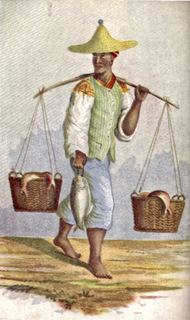
Cape Slave Fisherman.
Image courtesy of Patric Tariq Mellét
The earliest written reference I know of to Cape pickled fish comes from Lady Anne Barnard (picture below) who, after visiting Meerlust farm in 1798, wrote that she was served 'fish of the nature of cod, pickled with Turmarick'.

Hildagonda J. Duckitt, one of South Africa's most esteemed historical cookbook authors, provided a recipe for sole pickled with mango relish, onions, 12 small chillies and a full quart of vinegar in her famous Hilda's 'Where Is It?' Of Recipes (1891).

Although the key ingredients of this well-loved staple have remained unchanged over time, there are hundreds of different recipes: each family has its own particular favourite, often a closely guarded formula.  In their brilliantly instructive book Cookery in Southern Africa: Traditional and Today (1970), Lesley Faull and Vida Heard give no fewer than four different recipes, of varying complexity, for 'ingelegde' [pickled] fish.  Faldela Williams, author of the definitive reference The Cape Malay Cookbook (1988), remembers this recipe from her childhood in District Six as a festive dish, reserved for high days and holidays.  Her recipe is a rather pared-down one, containing only nine pickling ingredients, while esteemed local foodie and wine writer Michael Olivier provides a more complex recipe for kerrievis [curried fish], containing 15 picking ingredients.

What all these recipes have in common is fish, onions, turmeric, salt, curry powder and the all-important vinegar.  Important, of course, because this is the acidifying agent that prevents bacterial growth and preserves the fish. In older recipes for pickled fish, the fried fillets are packed into jars, liberally doused with a very vinegary pickling solution and set aside in a cool place to keep for many weeks, or even months.

I find most ready-bought pickled fish (which is available in many supermarkets and delis in Cape Town) too aggressively vinegary and oily, so here is my version, which uses just a little vinegar and oil, and several pungent lemony ingredients. This pickle will not, of course, last for months in a jar, but you can keep it in the fridge for four to five days. This is lovely with fresh brown bread and butter, and crisp finely sliced iceberg lettuce.


Extra-Lemony Cape-Malay-Style Pickled Fish

For the fish:

1 kg firm-fleshed white fish, skinned and thoroughly boned (I used sustainable yellowtail)
½ cup (125 ml) flour, for dusting
salt and white pepper
3 Tbsp (45 ml) vegetable oil

For the pickle: 

4 Tbsp (60 ml) flavourless oil (sunflower or canola)
2 onions, peeled and sliced in rings (not too finely)
2 cloves garlic, peeled and finely chopped
a thumb-size piece of ginger, peeled and grated
4 bay leaves
6 fresh lemon leaves
3 whole white cardamom pods
1 tsp (5 ml) cumin seeds
1 large red chilli, deseeded and finely chopped
2 tsp (10 ml)  turmeric
1 tsp (5 ml) mild curry powder
1 Tbsp (15 ml) brown sugar
4 Tbsp (60 ml) white wine vinegar
1 tsp (5 ml) finely grated lemon zest
8 black peppercorns
1 tsp (5 ml) salt
the juice of 3 lemons
½ cup (125 ml) water

To top:
extra fresh lemon leaves

Cut the fish into portions each about the size of a deck of cards. Put the flour onto a plate and season with salt and white pepper. Heat the oil over a brisk flame in a frying pan. Dust each slice of fish in the seasoned flour, shake to remove the excess, place in the hot oil and fry, in batches, for 2-3 minutes on each side, or until golden brown on both sides and just cooked through.  Remove from the heat and set aside.

Now make the pickling mixture. Wipe the pan clean of oil and residue using a piece of kitchen paper. Heat the vegetable oil in the pan, over a medium-high flame. When the oil's good and hot, add the onion rings and fry for three minutes, or until they beginning to colour, but still retain a good crunch.  Add the garlic, ginger, bay leaves, lemon leaves, cardamom and cumin seeds and cook, stirring gently, for another minute or two, taking care not to let the garlic brown.

Now add the chilli, turmeric, curry powder, sugar, vinegar, lemon zest, peppercorns and salt. Turn down the heat and bubble gently for two minutes, or until the mixture has reduced slightly, and the strong vinegary flavour has cooked away.

Stir in the lemon juice and water. Simmer for another minute, then remove from the heat.

Tip half of this mixture into the bottom of a ceramic or plastic dish just big enough to hold all the fish in a single layer. Pour the remaining mixture on top, making sure every piece of fish is well coated with the pickling liquid.  Top with a few extra lemon leaves, cover the dish tightly with clingfilm or a lid, and refrigerate for at least 12 hours - preferably 24 - turning the fish now and then in its pickle.  Serve cold, with buttered brown bread.

Makes 1 kg pickled fish Print Friendly and PDFPrint Friendly

Saturday, 6 February 2010

Chilli Snoek Pâté: a taste of Hout Bay

Chilli Snoek Pâté: a taste of Hout Bay
Please admire the little double-walled amuse-bouche dish,
 from a bespoke set of dinnerware made for a famous Franschhoek
 restaurant by my uncle, master potter David Walters.
Few tastes capture Cape Town as delightfully as smoked snoek pâté.  When you visit Cape Town you will find this noble fish - an honoured staple for centuries - virtually everywhere you go along the coast.

You'll see fishing boats avalanching their silvery cargos of fresh snoek onto the quayside at little working harbours, you'll see it it vlekked (gutted and splayed) on drying frames, you'll see it sold in oaked-smoked fillets, you'll see smoorsnoek, and you'll see it sizzling over braai fires.   You're most likely, though, if you're a casual visitor to the city, to encounter it in the form of a salty, smoky pâté.

Today I spent a happy hour in the kitchen with my darling friend Claire (here from Jo'burg for the weekend), concocting our visisticated version of this dish. Claire was driven in a taxi from the airport to her brother's fabulous flat in Kalk Bay, and was inspired by a discussion she had with the driver and his wife. Just outside Muizenberg, they passed racks of golden snoek drying in the sun, and the conversation turned to recipes for preparing the fish.  The driver and his wife told Claire stories of  being put to work as children by their grandmothers: their task was to pound fresh red chillies and deboned salted snoek together in a mortar; the resulting paste was spread on bread.

After a walk on the beach this morning, and a sinful bockwurst roll at Muriel's Munchies, we  picked up a package of  oak-smoked snoek at Hout Bay harbour, gathered chillies, coriander and lemons on the way home and set to work producing snoek pâté, only better - with pounded chillies.

 Please do not be put off by the fact that this recipe contains a whole red chilli.  When you first taste it, you may be alarmed and think your mouth has caught fire.  But, given four hours in the fridge, this pâté mellows  and the chilli fades, leaving just a tingle.

You can pound these ingredients together with a mortar and pestle in the old-fashioned way, or use a food processor fitted with a metal blade. The important thing here is not to over-process the pâté: it should not be whizzed to a silken paste, but retain some texture.

Chilli Snoek Pâté: a Taste of Hout Bay

250 g oak-smoked snoek [or any similar smoked white fish]
1 red chilli, halved and deseeded
a big pinch of coarse salt
half a clove of fresh peeled garlic
½  tsp (5 ml) finely grated lemon zest
2 Tbsp (30 ml) soft butter
3 Tbsp (45 ml) crème fraîche
milled black pepper
1 Tbsp (15 ml) finely chopped fresh coriander [cilantro]

Flake the fish into a small bowl and remove all bones. Put the chilli into a small mortar with the salt and garlic; pound to paste. If you don't have a mortar, finely chop the chilli and garlic and mash into a paste with the salt using the back of a spoon or a knife. Set aside.

Scrape the chilli and garlic paste into the bowl of a food processor fitted with a metal blade. Add the flaked fish and all remaining ingredients. Pulse lightly to combine without pulverising the fish. Tip the mixture into a little bowl and refrigerate for three to four hours.

Serve with sliced wholewheat seed loaf or crackers.

Serves 6 as an appetiser or dip.


Print Friendly and PDFPrint Friendly

Monday, 23 November 2009

Off to Cape Town, and a whole new food adventure

A view of the bay, from Chapman's Peak Drive
Oh Scrumptious friends, one and all, please forgive me for not having posted new recipes recently. Our entire family - kids, dogs, furniture, plants - is moving to Hout Bay, Cape Town, in a week's time, and I have had neither the time nor inclination to cook.

My batterie de cuisine (apart from a few spoons, cups, plates, and an electric frying pan) has been boxed and taped shut, and I'm spending most of my days teetering on a ladder turfing out the contents of my shelves and cupboards.

Packing up a house is spine-crunching work (I'm not the spring chicken I used to be) but at the same time it's wonderfully cathartic, and I feel fizzily invigorated after dumping a third of my books, and many boxes of junk (or what my local, fund-starved library eagerly calls 'brick-a-brack'.)

Beautiful Hout Bay harbour. 
I cannot tell you how dizzily delighted I am at the thought of moving back to Cape Town, where I lived with my husband for nine years BK (Before Kids).  I feel so lucky to be going back to a city I love, and one that is surely among the most astonishingly beautiful places on Earth.

What's more, I have two sisters who live in Hout Bay (they inconsiderately moved there some years back, the shameless trollops, leaving me with no babysitting support, no chance to really get to know my nieces and nephews, and no opportunity for regular family jollifications).

My lovely mum, who also joined this reverse Great Trek, lives an hour away from Cape Town, in Franschhoek, right next door to my dear uncle, aunt and cousins. And then, oh, delight, there are many old friends, some of them recently settled in Cape Town, others I got to know during the Eighties, and all of whom I have sorely missed.  And then, of course, there are my virtual friends, the food bloggers of Cape Town, who have so enthusiastically supported this blog.

But there's another reason I can't wait to get to Cape Town: the restaurants, the markets, and the beautiful fresh produce that flows into the city from farms and smallholdings on its outskirts, and further afield.

And, please excuse me while I faint at the thought: fresh fish whenever I want (and can afford!) it. Our new house is ten minutes away from Hout Bay harbour which, despite attracting gazillions of tourists in summer, is as delightful and authentic a fishing harbour as you are likely to find anywhere in the world: it remains a working harbour, with many of its fishing boats worked or owned by fisher-people who've lived in Hout Bay for generations.

I'm not very experienced at cooking seafood (good, fresh fish is just so expensive in Johannesburg) and I really look forward to sharing my cooking adventures with you.  There'll be a silence on this blog for two weeks or so, while I drag our travelling circus southwards, and when January comes, I'll be diving into my tiny (but perfectly formed) new kitchen to try out some new recipes.

Print Friendly and PDFPrint Friendly