Showing posts with label banting. Show all posts

Friday, 23 May 2014

Creamy Low-Carb Cauliflower-Cheese Soup with Lemon Butter & Bacon

A quick yet deep-flavoured soup with a whisper of nutmeg, a luxurious topping of crisped bacon and swirls of lemony butter. This is a new low-carb version of my 2009 recipe for Cauliflower-Cheese Soup: because I've given up on carbs it contains not a speck of flour, not a cube of potato, nor any similar starchy thickening agent.  This is gluten-free, diabetic-friendly, and well suited to anyone on a Low-Carb High Fat (#LCHF) regime.

Creamy Low-Carb Cauliflower-Cheese Soup with Lemon Butter & Bacon

The zesty lemon butter adds extra gorgeousness, and I've thrown in a few tablespoons of baby capers because I love their mysterious sage-green flavour. You can omit both of these if you like, and serve the soup on its own, or with my no-carb halloumi 'croutons', or a dobble of extra cream plus a shower of snipped chives.

This is lovely topped with crumbled blue cheese - try it with creamy Gorgonzola - and also good with slices of pan-crisped chorizo, plus fresh sage leaves frizzled in olive oil.

This soup takes less than 30 minutes from start to finish.  To find out why I think many soups should be cooked quickly and not boiled for hours, read my 10 Top Tips for Making Memorable Soup.

The only important watchpoint in this easy soup is adding the right amount of water. Too much and your soup won't be thick enough. Follow my recipe to the letter, and you can't go wrong.

Creamy Low-Carb Cauliflower Cheese Soup with Bacon Bits, Lemon Butter & Capers

2 small heads (500 g each) cauliflower
2 large onions
3 Tbsp (45 ml) olive oil
2 small cloves garlic, finely chopped or grated
a sprig of fresh thyme [optional]
1 litre hot chicken or veggie stock (if you don't have home-made stock to hand, make one by combining a few teaspoons of a Nomu fond or a Knorr Stock Pot with a litre of hot water.)
1 cup (250 ml) grated Cheddar, loosely packed in the cup
a pinch or two of nutmeg, to taste (See Cook's Notes, below)
½ cup (125 ml) cream
salt & milled black or white pepper, to taste

For the topping:
8 rashers streaky bacon, chopped
4 Tbsp (60 ml) butter
the zest and juice of half a small lemon
3 Tbsp (45 ml) baby capers

Trim the cauliflowers by slicing away the thick stalks and removing any green leaves.  Break the florets into small even-sized pieces and set aside.

Peel the onions, cut in half lengthways and slice into thin crescents.

Heat the olive oil in a large pot and fry the onions over a very gentle heat for 6-8 minutes, or until they are soft and just beginning to turn golden. Add the garlic and thyme sprig and cook for another minute, stirring, without allowing the garlic to brown. Add the cauliflower florets, all in one go.

Now pour in the hot stock. It should just cover the cauliflower florets - it's okay if a few of them are poking their heads above the water line. Cover the pot with a tilted lid, turn up the heat to a brisk bubble and cook for 15-20 minutes, or until the thickest cauliflower stalk feels very tender when poked with the tip of a sharp knife.  Remove the thyme sprig.

Blitz the soup to a fine, thick purée using a stick blender, liquidiser or food processor fitted with a metal blade. Gently reheat the soup, and when it is just beginning to boil remove it from the heat and stir in the grated Cheddar.  When the cheese has melted into the soup, add the nutmeg and cream and season to taste with salt and pepper.

If the soup seems too thick, thin it down with a splash of milk.

To prepare the toppings:  Fry the bacon bits over a medium heat until they're crisp.  Drain on kitchen paper and set aside.

Gently melt the butter (you can do this in your microwave oven, or over a very low heat in a small saucepan). When the butter has just melted, stir in the lemon zest and juice.

To serve the soup, ladle it into bowls and top with crisp bacon bits, a dobble of hot lemon butter and a sprinkling of capers.

Serves 6. 

Cook's Notes:
  • Nutmeg and cauliflower have a great affinity, but use the spice sparingly as it can easily overpower the delicate flavour of this soup.  A few gratings from a whole nutmeg will do fine, or use a pinch from a bottle of powdered spice.  Let the soup stand for a few minutes, so the spice can 'blossom', then taste it. If you can just detect the nutmeg, that's perfect!  If not, add another pinch.
  • The same applies to white pepper - it's delicious with cauliflower, but if you add too much, its pungent somewhat dusty flavour will take over.  Again, start with a pinch.

Print Friendly and PDFPrint Friendly

Friday, 9 May 2014

Spicy Low-Carb Roast Chicken & Tomato Soup with Halloumi Croutons

This creamy winter soup is spiced with a light touch because I want its hero ingredients (glorious roast chicken and ripe tomatoes) to sing out like a two-angel choir. I cannot resist a ready-roasted chicken, with its sticky golden skin and melting flakes, and fresh tomatoes - packed as they are with lip-smacking umami - add irresistible depth of flavour. This recipe contains not a speck of wheat or corn, nor any similar thickening agent. Although cooked tomatoes contain some teeny-weeny carbs, they have a low glycaemic-index ranking, making this recipe suitable for diabetics, or anyone on a low-carb, high fat regime.

Spicy Low-Carb Roast Chicken & Tomato Soup with Halloumi Croutons

You can, of course, roast your own chickens from scratch, but why bother? I don't think it's possible to achieve, in a domestic oven, the fall-apart texture and all-over goldenness produced by an industrial rotisserie. I use Woolies roast chickens because I think they're the best, but any good ready-roasted bird will do.

Like all good soups and stews, this dish tastes more beautiful and complex the day after you've made it.

Because it contains no starch, this soup relies for thickening on fast and furious boiling. It's an old-fashioned idea that soups need to be simmered for hours; I believe that a quick cooking time helps to retain the sparkle of the fresh ingredients. (More about that here - My Top Tips for Making Memorable Soup.)

This soup relies on fast boiling to reduce its tomato & leek base to a beautiful intense thickness.

If you're in a rush and don't want to make the quick stock called for in this recipe, use two 500 ml cartons of chicken stock in its place.

I've added the halloumi croutons because I desperately miss the carb-packed bready ones. Halloumi cheese makes a gorgeous substitute for crunchy cubes of oil-sizzled white bread, but it is bulging with calories, so I try to add just a few nuggets to soups, and to the top of steamed or braised veggies.

Please choose a very firm halloumi cheese for perfect croutons - if it's at all soft or yielding to a finger-prod, it will collapse in the pan and leave its sticky brown crust behind when you try to prise it away. For more advice about frying halloumi, click here > Top tips for frying halloumi.


Low-Carb Roast Chicken & Tomato Soup with Halloumi Croutons

2 small ready-roasted chickens
1 litre water
500 ml boxed liquid chicken stock (or two teaspoons of concentrated chicken stock or jelly - such as a Nomu fond, or a Knorr Chicken Stock Pot - dissolved in the same amount of water)
4 large leeks, white and pale green parts only
2 Tbsp (30 ml) olive oil
4 cloves garlic, peeled and finely chopped
9 ripe tomatoes
1 x 410 g tin whole or chopped Italian tomatoes
1/3 cup (80 ml) dry white wine
salt and milled black pepper
1 tsp (5 ml) chilli flakes, or more, to taste
1 tsp (5 ml) ginger [the dried powder]
1½ tsp (7.5 ml) cumin
¼ tsp (just a pinch!) cinnamon
1/3 cup (80 ml) cream
4 Tbsp (60 ml) finely chopped curly parsley

For the halloumi croutons:

a small block (about 150 g) halloumi cheese
4 Tbsp (60 ml) sunflower or a similar vegetable oil, for frying

Rotisseried chickens like these Woolworths ones drive me
into rapures. They're always a bit flabby the time I
get them home, but the flavour of the skin is gorgeous.
Remove the wishbones at the neck ends of the chickens (this is easily done by hooking your fingers underneath the bones and tugging them away). Using a sharp knife, remove all four breasts, each in one piece, taking care not to dislodge the skin.  Set to one side and keep warm.

Strip the remaining flesh from the chickens, removing any skin or gristle. Tear it into shreds, cover and set aside. Put all the bones and skin into a small deep pot and add a litre of water plus 500 ml chicken stock (see my notes in the ingredient list and opening paragraphs, above).  Bring to the boil and cook at a lively bubble, uncovered, for 30 minutes, skimming off any scum as it rises.

While the stock is boiling, prepare the leeks by trimming off the dark-green upper parts and making a long horizontal slit three-quarters of the way through their lengths.  Fan out the ‘pages’ of the leeks under a cold running tap and rinse away any grit hiding in the outer leaves.  Now cut the leeks into fine slices.

Heat the olive oil in a new pot and add the sliced leeks. Fry them over a medium heat for 5 minutes, then cover with a lid and braise gently for 10-15 minutes, or until they are soft.  Stir in the garlic and cook uncovered for a further 3 minutes, without allowing the garlic to burn or catch.

In the meantime, cut the tomatoes into quarters and place half of them in the jug of a liquidiser (or a food processor fitted with a metal blade).  Add a ladle or two of the hot chicken stock so the blades can turn freely, and whizz to a fine pink liquid. Now add the remaining quartered tomatoes and the tin of tomatoes, and blitz until just blended. If you don't have a liquidiser, you will need to grate all the tomatoes, or chop them finely.

Tip the whizzed-up tomatoes into the pot containing the leeks, add the wine, and season with salt and pepper. Turn up the heat under the pot and cook over a very high heat for 15 minutes, skimming off any pink foam that rises to the top.  This mixture will reduce and thicken quite quickly. Pour the stock into a colander set over a bowl, and discard the bones and skin (or give them to the dogs).

Now measure out one litre of your chicken stock and add it to the pot containing the leeks and tomatoes. Reserve any remaining stock. Turn up the heat and cook at a fast rolling boil for about 25 minutes. You'll know it's ready for blitzing when the liquid has reduced by about a quarter, and is beginning to look thicker.

Blitz the soup using a stick blender, then add the
chicken and spices.
Blend the soup to a fairly fine purée using a stick blender (or a liquidiser). Add the chilli flakes, ginger, cumin and cinnamon, along with the shredded chicken bits you set aside earlier. Turn the heat down to medium-low and simmer for 6-8 minutes.

Add the cream - a dribble at a time, stirring well between each addition to prevent it from curdling - and check the seasoning, adding more salt and pepper if necessary. If the soup seems a little thick, thin it down with a little of your reserved chicken stock.

Now for some last-minute preparation. To make the halloumi croutons, heat the oil in a small frying pan.  Cut the cheese into pieces the size of playing dice, and pat them very dry on kitchen paper to remove any brine. Fry the cubes over a medium-high heat for a minute or two, turning once, and watching them like a hawk because they brown and burn in a flash!

Drain the cubes on several layers of kitchen paper, blotting them well to remove any oil.

Cut the reserved warm chicken breasts into 7-mm slices, making sure each slice is topped with a strip of golden skin.

To serve the soup, ladle it into bowls, scatter with a few halloumi croutons and top with slices of roast chicken breast. Shower with chopped fresh parsley and serve immediately.

Serves 6-8.


Print Friendly and PDFPrint Friendly

Saturday, 3 May 2014

Low-Carb Lemon & Turmeric Meatballs in Lettuce Cups, with a Creamy Tahini Sauce

You can add any spices and aromatics you fancy to these juicy no-carb meatballs. I've included two hefty teaspoons of turmeric (because scientists keep discovering the amazing health benefits of this interesting yellow root) plus lemon zest for zing, and the usual warming spices I love so much -  cumin, coriander and smoked paprika. These are quick and easy to make because there's no arduous peeling, chopping or frying of onions involved, nor any whizzing-up of breadcrumbs.

Lemon & Turmeric Meatballs in Lettuce Cups, with a Creamy Tahini Sauce

Chives add a mild oniony bite, and a few dollops of  Greek yoghurt keep the meatballs nice and soft. If I wasn't on a low-carb regime, I'd serve these heaped over hot couscous perfumed with fresh mint and coriander, or perhaps with my aromatic naartjie couscous or Citrus Couscous Salad.  But I have to say they're also very good in crisp little iceberg lettuce cups piled with chopped cucumber, fresh mint and a creamy tahini sauce.

I particularly love the combination of hot and cold in this dish.  The meatballs must be very hot when you add them to the lettuce cups, and the tahini cream sauce very cold. The sauce is mild, delicate and creamy, containing Greek yoghurt and - something that is so allowed on my diabetic regime - a little cream to round out the flavours. I like tahini, but I often find traditional Mediterranean tahini sauces (basically, sesame-seed paste whisked with water, garlic and lemon juice) thin and somewhat bitter.

The only important watchpoint is to use fresh tahini that is still fairly runny.  Tahini tends to stiffen in the jar as it ages, and it also oxidises quite quickly, even if you've stored it in the fridge. If you can't easily spoon it out of the jar, throw it out and buy a fresh jar.

If you're not a fan of tahini, serve these meatballs with hummous, or tzatziki, or garlicky home-made mayonnaise.

This recipe makes a large quantity - around 48, depending on the size you roll them to.  Put the raw meatballs into a lidded plastic box, and they will keep in the fridge for two days. Alternatively, you can freeze them - still raw - then defrost them overnight in the fridge before frying them. You can make these using beef mince alone, or a combination of pork and mince (I often add ground pork to meatballs because it adds a special juiciness), or even with chicken mince.

Lemon & Turmeric Meatballs in Lettuce Cups, with a Creamy Tahini Sauce

For the meatballs:
1 kg beef mince, or a combination of beef and pork mince; or chicken mince
finely grated zest of a big lemon
4 Tbsp (60 ml) Greek yoghurt
1 large free-range egg, lightly whisked
a bunch of chives, finely snipped (about 5 Tbsp/75 ml)
1 clove garlic, peeled and crushed (or more, to taste)
1 tsp (5 ml) salt
1 tsp (5 ml) coriander powder
1 tsp (5 ml) chilli powder
1 tsp (5 ml) smoked paprika [optional]
2 tsp (10 ml) turmeric
2 tsp (10 ml) cumin
freshly ground black pepper
vegetable oil, for frying

To serve:
tahini cream sauce (see below)
2 iceberg lettuces
1 large English cucumber, finely chopped
a few sprigs of fresh mint

For the tahini cream sauce:
4 tsp (20 ml) fresh tahini
1 cup (250 ml) thick Greek yoghurt
1 clove garlic, peeled and crushed (or more, to taste)
the juice of half a big lemon
3 Tbsp (45 ml) cream
salt and a pinch of white pepper

First make the meatballs. Combine all the ingredients in a  big bowl, and use your hands to squish and squeeze the mixture so everything is very well combined.  Be warned: turmeric can stain your hands! I use thin plastic deli gloves when I'm making these.

To test the seasoning, make a tiny patty with the mixture and fry it in a lick of oil until it's cooked through.  If you think it needs more salt or spiciness, adjust the mixture to your liking.

Roll the mixture into small neat balls, each about the size of a large marble, and arrange them on a big plate or tray. Place them, uncovered, in the fridge for 20-30 minutes to firm up.

Heat the oven to 180 ºC and place a baking sheet or roasting tray in it to heat up.

While the meatballs are chilling, make the tahini cream sauce.  Place all the ingredients in a  bowl and whisk until smooth. If your tahini paste is a little stiff, use a blender to whizz everything together. Tip the sauce into a bowl, cover it with clingfilm and refrigerate.

Arrange the meatballs in a circle in your pan, so
you can flip them over in the order in which
you added them.
Now cook the meatballs. Heat a little sunflower oil in a large frying pan, and when it is hot and shimmering, add eight to ten meatballs.  When I'm frying meatballs, I always arrange them in a circle in the pan so I can flip them over in the order in which I added them.

Fry the meatballs for one or two minutes, or until golden and crusty on the underside, then flip them over and continue to fry for a further two minutes. Lift the meatballs out of the pan, and slide them onto the preheated roasting pan in the oven so they can finish cooking for a further ten minutes or so. Repeat this process with the remaining meatballs.

In the meantime, use a sharp knife to cut out the cores of the iceberg lettuces.  Strip off and discard the outer limp leaves, and remove the inner leaves, each in one piece.  Arrange the lettuce cups on a platter, and add a few tablespoons of chopped cucumber to each one.

Tuck a few hot meatballs into each lettuce cup, drizzle over the cold tahini sauce and top with a sprig of mint.

Makes about 48 meatballs, and serves 6-8. 


Print Friendly and PDFPrint Friendly

Monday, 3 March 2014

Low-Carb Parchment-Baked Feta with Thyme & Chilli

A puffed-up parcel of melty feta, hot and rustling from the oven, makes a splendid snack when you're entertaining friends and family.  Part of the fun of food baked in paper is tearing open the parcels and inhaling the gorgeous aromatic steam, so bring this straight to the table and open it in front of your guests.

A slab of flavoured feta cheese resting on fresh vine leaves and
 baking paper, ready for wrapping and baking.

Mild, creamy feta cheese is perfect for baking en papillote because it so eagerly accepts other punchy flavours.  In this dish, I've flavoured the feta with a simple combination of fresh thyme, black pepper and chilli flakes, but you can add any other ingredients you fancy - garlic, rosemary, lemon zest, chopped olives, sundried tomatoes, preserved lemons, and so on.

I make two or three of these when I'm expecting a crowd, and I accompany the dish with crisp cubes of watermelon or prickly pear, or ripe baby figs (see picture below).

Served with slim iced celery sticks, this is a great choice of starter if you or any of your guests are on a low-carb or diabetic regime.

In the picture above, I've lined the baking paper with some fresh leaves from my grapevine, but you can omit these, or use baby spinach leaves.  

Wrap the feta in baking paper, and secure the parcel
with raffia or kitchen string.


Serve the hot feta parcels with ripe baby figs or crisp watermelon cubes, or with chilled
celery sticks if you're on a low-carb eating plan. Plate by David Walters


Parchment-Baked Feta with Thyme & Chilli 

1 x 250 g slab of feta cheese
5 fresh vine leaves or baby spinach leaves [optional]
1 tsp (5 ml) dried chilli flakes, or more, to taste
a few sprigs of fresh thyme
milled black pepper
2 Tbsp (30 ml) fruity olive oil

Heat the oven to 190 ºC.  Place a rectangle of baking paper on your countertop and arrange the grapevine or baby spinach leaves in the centre. Position the slab of feta cheese on top of the leaves and sprinkle over the chilli flakes, thyme and pepper. 

Trickle the olive oil all over the cheese, then fold the paper up to create a parcel, as if you are wrapping a birthday present.  Don't wrap it too tightly - there needs to be some leeway so the parcel will puff up in the oven.  Secure the parcel with a length of raffia or kitchen string. 

Slide the parcel onto a baking sheet (or place it in a ceramic dish) and bake at 190 ºC for 12-15 minutes, or until it is piping hot and puffed. 

Serve immediately.

Serves 4 - 6 as a snack. 


Print Friendly and PDFPrint Friendly

Wednesday, 25 September 2013

Low-Carb Tomato, Mozzarella & Chorizo Salad with Caperberries and Basil

It's food heresy to tinker with the three perfect elements of a Caprese salad, but I felt I had to, because the tomatoes I bought yesterday weren't very alluring. Although they fell short of being mealy on the inside, they were neither sweet nor acidic, but somewhere in between, with a top note of tasteless. So I dollied up the dish with some paper-fine chorizo slices, a handful of caperberries, salt, pepper and basil oil, left it to stand for an hour so the salt could draw out the juices, and then fell on it like starving wolf.

Tomato, Mozzarella & Chorizo Salad with Caperberries
Tomato, Mozzarella & Chorizo Salad with Caperberries.
Plate by David Walters.
I'm going to make this again because I love the smoky taste of the chorizo with tomatoes, basil and cheese, and because it's so easy to fling together.

Use ordinary capers if you don't have caperberries and, if you can afford it, an authentic milky-soft mozzarella, not the bog standard supermaket variety. If you can't find pre-sliced chorizo leaves like the ones in the pictures, buy a whole sausage and asked the staff at the supermarket deli counter to cut it very thinly on their magic slicing machine.

Tomato, Mozzarella & Chorizo Salad with Caperberries
Leaving the salad to sit for an hour allows the flavours to mingle
I am going to make a vast platter of this as a starter next time I have friends over for a feast. I haven't thrown a long, lazy weekend lunch since... well, I can't remember when last I cooked for a crowd. It's been such a cold and wet winter here in Cape Town, and I haven't felt in the mood. It's not that I mind spending a lot of time in the kitchen preparing a feast - it's the clearing up and the staggering price of food and booze that puts me off.

How often do you have lunch parties? How much do they cost you? Tell me in a comment!


Tomato, Mozzarella & Chorizo Salad with Caperberries

4 large, ripe tomatoes
12 large, thin slices chorizo sausage
12 slices mozzarella
16 caperberries, or 4 Tbps (60 ml) capers
a small bunch of young basil
flaky salt
6 Tbsp (90 ml) extra-virgin olive oil
half a lemon
milled black pepper

Arrange the tomato, chorizo and mozzarella slices on a platter in overlapping circles, and strew the caperberries and half the basil over the top (use the smaller leaves).

Put the remaining basil leaves  into a mortar and add a pinch of flaky sea salt. Pound the leaves to a paste, then stir in 3 Tbsp (45 ml) of the olive oil.

Place little dabs of the basil oil all over the salad.  Sprinkle with the remaining olive oil, and spritz the salad with lemon juice, to taste.  Season with more salt and plenty of black pepper, and set aside, covered, on the counter top for an hour.

Serve with bread.

Serves 4 as a starter; 2 as a salad.


Print Friendly and PDFPrint Friendly

Saturday, 24 August 2013

Easy Maas (Amasi) Drained Cheese with Capers, Radishes & Herbs

A creamy, delicate white cheese that's incredibly easy and inexpensive to make. I'm excited to share my recipe with you, and hope you'll try it, because it's so versatile and delicious. I've used a beloved Southern African staple ingredient - amasi, or maas, a soured/fermented milk - to create this drained cheese, and combined it here with some spiky contrasting flavours.


Easy Maas (Amasi) Drained Cheese with Capers, Radishes & Herbs
Radishes, capers, lemon zest, olive oil and salt contrast with the
delicate milky flavours of the maas cheese.  I've used rocket and parsley
 seedling leaves from my garden to strew over the cheese. 

If you're fed up with paying through the nose for cream and cottage cheeses, you'll love this method of making your own soft white cheese at home. A two-litre bottle of amasi retails for around R25, so the cheese shown in the picture above, made from a one-litre bottle of maas, will set you back about ten rand.

I can't understand why amasi doesn't feature more prominently in restaurant dishes or, for that matter, in workaday South African recipes. Full-fat maas is a superb local ingredient: it has a light, tangy taste, it's pleasingly creamy, and it has many well-documented health benefits


Easy Maas (Amasi) Drained Cheese with Capers, Radishes & Herbs
The shiny slick visible at the top of this beautiful plate is not
 olive oil, but a brush-mark of fired-on, glassy glaze, placed there for a
 specific reason by my uncle, master ceramicist David Walters. More about
 this towards the end of this blogpost!  

Amasi also has multiple uses in the kitchen. You can use it in place of natural yoghurt (my obsession this year!) in many dishes: it's a good tenderising agent in marinades for chicken and red meat, it's lovely in raitas, salad dressings and creamy dips, and it's useful for dolloping at the last minute into curries and similar spicy stews. I always add maas to fruit smoothies, and often whizz it up with frozen cubes of fruit to make instant ice cream.

It's also an excellent alternative to buttermilk and/or yoghurt in scones and quick breads: the best scones I've ever tasted are made with maas: you can find the recipe for Irene Ngcobo's legendary feather-light scones here, on my Scrumptious Facebook page.

If you're wary of maas because it sometimes has a slightly lumpy texture, don't worry! The long draining process produces a beautifully creamy, smooth-textured cheese, all on its own, without any need for stirring.

You can lightly knead this cheese (once it has finished draining) with salt, pepper, garlic, herbs and any other zippy flavours you fancy, but I think it's best just as it is, with all the bells and whistles served on the side of the plate. I love the contrast of the delicate milky-bland flavours and a few crunchy/sour accompaniments, mashed together under a fork with plenty of fruity olive oil and flaky sea salt.

Try it, also, with ribbons of honey and a scattering of toasted flaked almonds or pistachios, or with stewed grapes or baked figs.  Or roll the cheese into balls, coat them with pepper and marinate them in olive oil, rosemary, garlic and similar sunny Mediterranean flavours (see picture below).

Easy Maas (Amasi) Drained Cheese with Capers, Radishes & Herbs
Maas-cheese balls rolled in pepper and smoked
paprika, and marinated in olive oil, garlic and rosemary.
  Plate by David Walters

There's nothing mysterious about this recipe: it's a basic drained cheese, similar to a Middle-Eastern labneh. If you're not in Southern Africa, you can make this using Greek yoghurt (here's my recipe for a garlicky, herby yoghurt cheese).

Finally, a note about the beautiful black plates in the pictures above. My uncle David Walters, master potter of Franschhoek, works closely with some of South Africa's top chefs to produce bespoke dinnerware for their restaurants. He's designed these matte black plates with great care and attention, brushing a slick of shiny glaze right across its middle  Why? Because he doesn't want your fork to make a nasty scraping fingernails-on-blackboard noise as you clear the plate.

Which brings me to a little grumble. As I may have mentioned on this blog before, I can't bear good food served on rough slate roof tiles, a gimmick that has spread like a black fungus all over the restaurant world. (I was annoyed to see this fad eagerly reproduced by contestants on the latest series of South African Masterchef, along with the ubiquitous spoon-dragged 'swoosh' of sauce, or what I like to call a Plate Skidmark.) There are many studio potters in South Africa producing the most beautiful hand-made dinnerware, and I wish restaurateurs would support them, instead of buying their 'crockery' at builders' yards.

My feeling is this: if you're going to spend a lot of time and effort making exquisite, flavoursome food, please dish it up on a spotlessly clean, unchipped, smooth piece of porcelain, preferably a shining white or black plate with a lip  - or crafty concave surface - to prevent your jus from sliding off the edge.

Easy Amasi Drained Cheese with Capers, Radishes & Herbs

a litre of full-cream maas (I use Inkomazi brand)
baby herb leaves, to garnish
finely grated zest of half a lemon
Maldon flaky sea salt
freshly milled black pepper
1 cup (250 ml) small radishes, halved
4 Tbsp (60 ml) baby capers
4 Tbsp (60 ml) fruity extra-virgin olive oil
a squeeze of lemon juice, to taste

Line a large sieve with a closely woven cloth. I use a fine, clean cotton dinner napkin, but a brand-new J-Cloth (one of these) or a laundered dish cloth/tea towel will do just as well. Avoid waffle-textured cloths, however.

Place the cloth-lined sieve over a big bowl and pour in the maas.  Let it sit, undisturbed, for about 10 hours, or overnight.

The clear whey will drip into the bowl below, and it will also soak right to the edges of the cloth. Don't stir or scrape at the cheese: let it drain at its leisure.

Gather up the edges of the cloth, twist them tightly together and secure with an elastic band.

Hang the bundle over a bowl, or suspend it from a tap over the sink, for another 12-16 hours, or longer, if you'd like a firmer cheese. The longer you leave it, the dryer and denser it will become. If you don't have a tap like the one shown in the picture below, hang your cheese from a broomstick placed across the backs of two facing chairs, or a similar rig.

Easy Maas (Amasi) Drained Cheese with Capers, Radishes & Herbs
Hang the cheese up until you're
 satisfied with its texture.  
If you're going to hang it for longer than two days, or the weather is very hot, it's best to finish the draining process in the fridge. If your fridge has wire racks, clip the knot of the cloth to the rack with clothes pegs, and place a bowl underneath. If your fridge has glass shelves, you will have to hang the cheese in the coolest place in your house.

Tip the cheese out of its cloth onto a plate. Alternatively, you can press it firmly into a mould of some sort - a little bowl, or perhaps two small ramekins - a few hours before you serve it, and then unmould it onto a plate.

Scatter over the baby herb leaves and lemon zest, and season generously with salt and pepper. Arrange the radishes, capers and any other accompaniments around the cheese. Generously douse the cheese with olive oil, and finish off with a good spritz of lemon juice.

Serve with melba toast or crackers, or with celery and carrot sticks if you're on a low-carb eating plan.

Serves 4-6 as a snack.


Print Friendly and PDFPrint Friendly

Thursday, 15 November 2012

Low-Carb Recipes: 35 Scrumptious Dishes from South Africa

I've had a flurry of emails from readers since I featured three low-carbohydrate recipes on this blog in recent months, all from people who've been inspired by South African sports scientist Professor Tim Noakes' recent conversion to a low-carb eating plan.

My version of Indonesian Gado-Gado (recipe below)
People on this regime seem to struggle most with finding interesting, satisfying vegetable dishes. 'It's so difficult to enjoy a dinner without potatoes, rice or pasta,' one person told me. 'I need something more exciting than a pile of steamed vegetables.'

I reckon that if you embark on a restrictive eating plan like this, possibly as a long-term lifestyle choice, you definitely need some excitement on your plate. And what better way to pleasure your brain's food-centre than to introduce thrilling flavours that punch you in the tastebuds and deaden any residual cravings for sugar and starch?

So: I've put together this list of 35 of my original low-carb recipes, and I hope you find them useful and inspiring.

Note: I'm not affiliated in any way with Professor Noakes, nor am I endorsing his eating plan, which remains contentious.

However, I find myself drifting closer and closer to its general principles because I love eating this way.  I've never been a great fan of starchy, sugary things anyway, and every time I've embarked on a low-carb diet I've shed kilos quickly. However, I freely admit that I've put some of the lard on again: it's difficult to sustain this diet for more than a month at a time, when thunderous cravings for mashed potatoes, wine gums (oh, okay, wine) and chocolate set in.

If you'd like to know more about how to follow this low-carb lifestyle, I can recommend this article by Professor Noakes.

Postscript, 8 February 2014: I have lost 22 kg in four months, mostly by following a Noakes-style low-carb regime. But more about that in a future blogpost.

Postscript, 23 March 2014: Here is the future blogpost I mentioned  above: Hello diabetes, and how I have had to adjust my cooking style


Cottage Cheese, Herb and Olive Oil Smothering Dip  A useful, all-purpose, very garlicky cold sauce that packs a powerful flavour punch. Pour it all over whatever you're eating hot, and the warmth of the chicken, fish, steak or veggies will release the aromatic flavours of garlic, herbs and olive oil.  I always keep a lidded plastic container of this in my fridge and use it in place of mayonnaise.

Cottage Cheese, Herb and Olive Oil Smothering Dip


Low-Carb Green Bean, Tomato & Prosciutto Salad with Basil Oil A really easy and delicious throw-together salad featuring beautiful young green beans. Click through to my recipe to find a sneaky way of top-and-tailing a lot of beans in seconds!

Low-Carb Green Bean, Tomato & Prosciutto Salad with Basil Oil
Bean, tomato & proscuitto salad
Oven-Roasted Ratatouille I make a huge tray of this at least once a week in summer, because everyone in my family loves it hot and topped with grated Parmesan. It also makes brilliant leftovers: enjoy it cold, with shavings of Parmesan or cubes of feta cheese or shredded fresh basil.  Or whizz it up with some vegetable stock to make a soup or a sauce for pasta.

 My Lemony Green Beans with Aïoli.  Image by Michael Le Grange
 © Random House Struik 2012. Bowl by David Walters.

Lemony Green Beans with Frizzled Prosciutto, Fried Breadcrumbs & Aïoli 
Strictly speaking, you should leave out the fried breadcrumbs if you're on a low-carb diet. In the picture above, I've used toasted flaked almonds instead of breadcrumbs. This is a dreamy combination and one of my family's favourites.

Marinated Mushrooms with Green Beans and Feta I first learned how to make marinated mushrooms when I was twelve years old, and here I've adapted the recipe to bulk it out with squeaky-fresh green beans and feta cheese.

Warm Marinated Olives with Lime, Thyme and Chilli You won't be able to serve this with warm crusty rolls, as I've suggested in the recipe, but you can add cubed feta and halved cherry tomatoes just before you serve it to create a flavour-crammed starter or snack for a summer meal.

Braised Baby Leeks with Halloumi 'Popcorn'  An adventurous dish with knock-out flavours and textures. Leave the out the bread crumbs if you're on a strict low-carb regime.

Salad of Warm Baby Leeks with Blue Cheese and Chilli Croutons Again, you'll have to forego the chilli croutons. For this salad, baby leeks are simmered whole in water, with a little olive oil and some herbs and garlic. By the time the water has evaporated, the leeks are as tender as a mother's love. They are then left to colour slightly in the remaining oil, and served warm with crumbled blue cheese.

Cauliflower Salad with Crisp-Fried Chorizo Sausage and a Warm Lemon Dressing  An easy tapas-style dish with sensational flavours and textures: shaved raw cauliflower with crumbled fried chorizo, crisp breadcrumbs, a whisper of garlic and a warm lemony olive-oil dressing. Leave out the breadcrumbs if you're evangelical about this diet.

Make an open sandwich using a grilled chicken breast as a base, or pack the filling
between two breasts and secure with a skewer. 

Low-Carb Mediterranean Chicken 'Sandwich' 
I used grilled chicken breasts instead of bread slices to create this nutrient-packed lunch dish, which is packed with lovely sunny ingredients including feta, scorched tomatoes, olives, artichokes and rocket.

Spiced Baked Aubergines with Yoghurt  A plain dish with simple flavours, but you'll love it if you're a big fan of aubergines.

Pea & Pea-Shoot Salad with Bacon & Eggs
Pea and Pea-Shoot Salad with Bacon and Eggs  Peas do contain some carbohydrates, but this lovely warm-and-cold dish contains just half a cup of them per serving, so I figure that's permissible  If you can't find pea shoots, use fresh rocket, mustard greens, spinach or bok choy.

Halloumi and Beef Carpaccio Salad with Fried Capers The ultimate in indulgence when it comes to a low-carb salad, in my opinion: crisp-fried halloumi cheese, thin slices of seared beef fillet and crunchy fried capers on a bed of peppery rocket.  Here's another, similar salad: Halloumi Salad with Lemon-Caper Dressing.

Egg and Fennel Salad with Nasturtium-Leaf Mayonnaise This salad of boiled eggs and shaved fennel, dressed with a caper & anchovy vinaigrette and a nasturtium-leaf mayonnaise, is surprisingly light and delicate, considering how much oil and egg it contains. If you can't find nasturtium leaves, mix a handful of chopped fresh herbs of your choice into the mayonnaise.

Double-Egged Crustless Spinach & Bacon Tart It's difficult to believe that such a substantial tart contains very few carbs, but there is not a speck of flour, cornflour or added sugar in this easy recipe.

Warm Duck Salad (see below)

Warm Duck Salad with Crackly-Topped Beetroot  
Duck is very expensive, but you can stretch two breasts between four mouths in this gorgeous salad. You'll need to leave out the dried cranberries if you're on a strict regime.  See my comments about the glycemic load of beetroot below.
Roast Baby Aubergines with Rocket and Peppered Cream Cheese,and a Tahini Dressing  A scattering of toasted pumpkin seeds gives this salad a satisfying crunch and a good nutritional kick in the pants: they, along with the sesame seeds in the tahini dressing, are among the most wholesome plant foods on earth, in my view. Here's a similar recipe: Warm Grilled Aubergine Slices with Chilli and Pesto

Slow-Cooked Courgettes & Cherry Tomatoes with Melty Feta  A lovely, bright dish that's good both hot or cold.  The half-teaspoon of sugar is there to counteract the acidity of the tomatoes, but you can leave it out and add a tiny pinch of bicarbonate of soda instead.

Pretty Little Individual Tuna Salads I designed this recipe for kids, but this makes a lovely starter for a low-carb feast, and looks so tempting in its perky collar of cucumber. 

Salad of Shaved Baby Fennel, Apple and Smoked Mackerel
Salad of Fennel, Apple & Smoked Mackerel
'Carpaccio' of Kohlrabi with Radishes and Blue Cheese Adapted from a dish in Anton Mosimann's 1991 book Naturally, this is a most unusual starter with its combination of creamy blue cheese, crisp, paper-thin kohlrabi and peppery radish.

Salad of Shaved Baby Fennel, Apple and Smoked Mackerel  If you've never been a fan of fennel, do try it raw in this salad, which is wonderfully nutritious, containing as it does oily fish. You'll need to leave the chilli-dusted croutons out of the recipe, though. 

Wine-Braised Baby Fennel in Crisped Prosciutto Delicate little fennel bulbs with a wrapping of salty ham. Okay, this recipe does contain wine, but all the alcohol boils away during cooking.

Roast Beef Fillet with Creamy Celeriac-and-Horseradish-Cream Salad Celeriac isn't very starchy, which makes it a great substitute for potatoes. Here, I've combined it with a creamy remoulade-style dressing to make a cool topping for roast fillet.

Roast Ratatouille Soup with Basil Mayonnaise This glorious brick-red soup, one of my favourite recipes, contains neither starchy veggies nor any flour or similar thickening agent. It's easy to make, and tastes even better the day after.

Salmon, Beetroot & Rocket Salad
Low-Carb Salmon, Beetroot and Rocket Salad This is a simple salad, but so satisfying: the combination of roasted beetroot, peppery rocket, meltingly tender flakes of salmon and little bursts of tart sweetness from the pomegranate seeds makes me want to eat it every day. Beetroot has a moderately high glycemic index value of 64, but its glycemic load is only five.

My Aunt's Avocado Mousse  I see that Professor Noakes includes avocados on his list of low-carb foods, so I bring you this retrolicious dish: a wobbly, creamy mousse of the palest green, pepped up with a subtle crunch of fresh chives.

Michael Le Grange's photograph of my Peri Peri Calamari with
 Chouriço Sausage.  Image © Random House Struik 2012. 

Peri Peri Calamari with Chouriço Sausage 
Peri-peri is one of South Africa’s favourite flavours.  Feel free to add more fresh chillies if you appreciate a blisteringly hot sauce. (This recipe is taken from my cookbook Scrumptious Food For Family and Friends.)

Calamari Salad with Thyme, Lemon, Chilli and Olives  This light, summery seafood salad, sparked with lemon juice, red chilli and fresh herbs, takes just ten minutes to make and keeps very well in the fridge for three to four days.

Gado-Gado: a hot & cold salad with a spicy peanut sauce
My version of Gado-Gado. You'll have to forego the potatoes.

Gado-Gado
This delicious and unusual dish of cooked vegetables, crisp salad ingredients and boiled eggs smothered with a piping-hot, spicy peanut sauce is my take on Gado-Gado, a dish popular all over Indonesia. Peanuts have a very low glycemic index value, but please leave the boiled new potatoes out of this recipe!

Tomatoes Baked with Garlic Butter and Cream A sinfully rich dish because it's loaded with fat, but it's low in carbs, and brilliant as a special treat with bacon and eggs.

Asparagus with Egg Mimosa, Butter and Breadcrumbs  Based on a classic ‘Polonaise’ dressing, this topping may be old fashioned, but it’s a time-tested classic for good reason.  Cooked, sieved egg yolks are called ‘mimosa’ because they resemble the fluffy yellow flowers of the plant of the same name. The bad news: you'll have to leave out the breadcrumbs. (Another recipe from my cookbook.)

Rainbow Trout en Papillote with Lemon and Herbs Light, bright and singing with clean flavours, this is a dish that I make often, using a variety of fresh, sustainable seafood: farmed trout, angelfish, yellowtail, snoek and black mussels.

Easy Chicken, Feta and Bacon Roll-Ups in a Tomato and Rosemary Sauce  Chicken breast fillets stuffed with feta, garlic and sage, rolled in bacon, crisped in a hot pan and then simmered in a rich tomato sauce. A bit fiddly, but well worth the effort if you're cooking for a special occasion.

My Aunt Gilly's Egg 'Bavarois' Okay, you'll have to leave out the sweet-chilli sauce topping. But this delicate, old-fashioned buffet dish, lightly jellied and subtly flavoured with bay leaves, onion, cloves and nutmeg, is delicious with small, snappy gherkins and other pickles.

Seared Tuna with a Burnt Tomato & Caper Dressing
Seared Tuna with a Tomato & Caper Dressing

Seared Tuna with a Burnt Tomato & Caper Dressing This is an easy and interesting dish starring just a few beautiful ingredients - spanking-fresh tuna, olive oil, capers, baby herb leaves and Rosa tomatoes at the peak of their ripeness.


Print Friendly and PDFPrint Friendly

Sunday, 1 August 2010

Potted Pork Belly with Mace and Pepper, in the English style

A meltingly tender dish of slow-cooked pork belly, shredded, combined with mace, pepper and salt, packed into a pot and sealed with butter. These could, I suppose, be called pork rillettes, but they're not cooked in seasoned fat, as French rillettes are, and there is something very English about this dish.

Potted Pork Belly
Potted meats have a long history in English cookery: pounding cooked meat with butter and spices, and packing the mixture into porcelain pots, was an easy way to preserve surplus meat for long periods. Elizabeth David wrote a whole booklet on the subject, English Potted Meats and Fish Pastes, which she published privately and sold through her famous kitchen shop in Pimlico. Parts of this booklet (which is as rare as hens' teeth) are reproduced in her book 'An Omelette and A Glass of Wine', and to my fury I seem to have mislaid my copy of it. (Or I lent it to someone: don't get me started on that topic).

In this recipe, pork belly is slow-cooked in a bath of flavoured water until fork-tender. You can slow-roast the belly without water, if you like, but I prefer this method because you end up with a great bonus: a lot of rich, jellied, aromatic stock, which you can use in soups, stews and gravies.

Take the dish out of the fridge an hour or so before you serve it, so the mixture can be easily spread. Clarify the butter if you have the energy (see recipe) but this isn't necessary if you intend serving this within a day or so; the purpose of removing the milk solids from the butter in olden times was to prevent it from becoming rancid.

You can add as much or as little seasoning to this dish as your tastebuds demand: I prefer to keep the spices in the background. It does, however, need a lot more salt than you would think. Lovely with fresh bread or Melba toast, a few crunchy little gherkins and a dab of wine jelly.

Potted Pork Belly
one 1.5 kg pork belly
water
2 bay leaves
2 medium carrots, snapped in thirds
a sprig of thyme
a few parsley stalks
an onion, skin on, sliced
10 peppercorns
4 whole cloves
flaky sea salt
milled black pepper
1 tsp (5 ml) ground mace (or nutmeg)
cayenne pepper, to taste
2 tsp (10 ml) chopped fresh thyme leaves
½ cup (125 ml) butter

Preheat the oven to 130 ºC. Put the pork belly, skin-side up, in a deep  roasting pan. Pour in just enough water to barely cover the belly: the fat should be poking up out of the water. Add the bay leaves, carrots, thyme, parsley stalks, onion, peppercorns and cloves (but no salt). Cover tightly with a double layer of tin foil. Place the dish in an oven heated to 130ºC, and bake for 5-6 hours, or until the pork meat is so tender you can pull it apart with a fork.

Remove the belly from the pan, pull off the skin and discard it.   Strain the stock through a sieve into a clean jug.  Allow the belly to cool for 15 minutes, then pull the meat into shreds, using two forks or your fingers, and discarding any silvery bits of sinew, but retaining any soft white fat. Now coarsely chop the belly meat: it should look like mashed tuna. (You can pound it to a smooth paste, if you like, but don't put it in a food processor, which will ruin its texture).  Place in a bowl.

Add the salt, pepper, mace, cayenne pepper and chopped thyme, tasting the mixture as you go along until it is seasoned to your liking. Mix well and pack into a shallow terrine dish or individual ramekins. Pour just enough warm stock over the meat to moisten it well - it should not feel wet or saturated. Press down well and allow to cool.

Melt the butter in a saucepan and skim all the white foam off the top. Remove from the heat, allow to cool for a few minutes, and then strain through cheesecloth or a fine sieve onto the top of the potted belly. Place a bay leaf or a sprig of thyme on top, and press down well. Refrigerate.

Serves 6 as a starter. Print Friendly and PDFPrint Friendly

Saturday, 26 June 2010

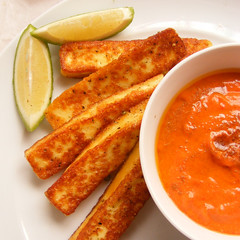
Peppered Halloumi with Red-Pepper Tahina Dip

A small amount of tahina adds a velvety texture to this vibrant dip of roast red pepper, olive oil and lemon. Served with a pile of crusty fried halloumi, this makes a great snack with drinks. It's very filling, and just as well, because halloumi is an expensive cheese.

Peppered Halloumi with Red-Pepper Tahina Dip
My Peppered Halloumi with Red-Pepper Tahina Dip
It's also packed with calories, so I don't buy it often (in spite of the implorings of my teen sons, who adore halloumi with bacon and eggs, and can demolish kilos of the stuff if given half a chance).

I was first introduced to halloumi-for-breakfast by my brother-in-law, who is of Cypriot descent, and it was he who showed me how to fry it in olive oil to rustling golden perfection.

He showed me, all right, but it took me a long time to figure out how to get a good result every time. Halloumi's tricky to cook: it burns in an instant, or goes floppy, or melts all over the pan, or toughens to boot leather in a matter of minutes. So how do you get it right?

First, the quality of the cheese is important. Some brands collapse in the pan; others are so saturated in brine that they never get really crisp, so it's worth experimenting with different brands. Woolworths have an excellent halloumi that is just right for pan-frying.


Peppered Halloumi with Red-Pepper Tahina Dip
Serve with lemon wedges.
Second, make sure you pat the cheese quite dry on kitchen paper before you fry it. Third, the oil should be very hot, but not smoking, and you need to watch the cheese like a hawk as it browns very quickly. Don't add too much oil - two tablespoons (30 ml) is enough - and don't overcrowd the pan.

Last, drain the halloumi well on kitchen paper to soak up excess grease, and serve immediately. The quicker you get it onto the plate, the less chance it has to soften up.

This vibrant red-pepper sauce is inspired by a recipe given to my by my aunt, Gilly Walters of Wedgewood Nougat.


Peppered Halloumi with Red-Pepper Tahina Dip

one x 300g block halloumi cheese
milled black pepper
olive oil for frying
lemon wedges

For the dip:
2 large red peppers [bell peppers]
2 large cloves garlic, peeled
2 Tbsp (30 ml) olive oil
4 tsp (20 ml) lemon juice
1 tsp (5 ml) cumin
1 tsp (5 ml) Tabasco sauce
1 tsp (5 ml) tahina
salt and milled black pepper

First make the dip. Heat the oven to 180 ºC. Cut a 2-cm slit in the side of each pepper and push the whole garlic cloves through the slits into the peppers. Place on a baking sheet and bake for 35-45 minutes, or until the peppers are soft and beginning to brown. Don't let their skins blacken.

Remove from the oven, place on a plate, cover, and allow to cool. Tear open the peppers and retrieve the garlic cloves. Pull off the skins and cores and discard the seeds. Place the pepper flesh and garlic cloves in a blender and add the remaining dip ingredients. Process to a smooth paste (add a little more olive oil or lemon juice if the blades are reluctant to turn). Decant into a bowl, swirl with a little extra olive oil and sprinkle with a pinch of cumin.

Cut the cheese into 7-mm thick slices. Pat very dry on kitchen paper. Rub a film of olive oil over the slices and coat generously, on both sides, with milled black pepper. Heat the oil - about 2 Tbsp - in a frying pan. When the oil is hot - a breadcrumb should fizzle vigorously in it - add the cheese and fry, in two or three batches, until golden-brown and crisp. This will take about a minute per side, depending on the heat of the pan.

Drain on kitchen paper and serve immediately, with the dip and some lemon wedges.

Serves 4 as a snack.

Print Friendly and PDFPrint Friendly